Eagle.io Alternatives: How Ubidots Compares After the Bentley Acquisition (2026)
"No development for 3 years" — and the bill is climbing toward $20K/month. Here's how Ubidots compares to Eagle.io on pricing, multi-tenancy, Python scripting, and white labeling after the Bentley acquisition.

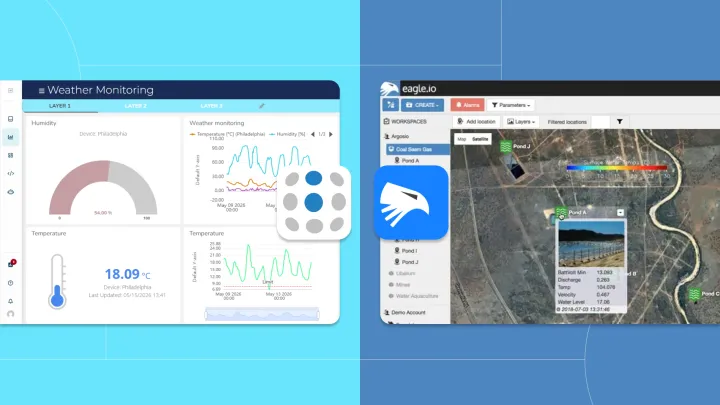
When Bentley Systems acquired Eagle.io in August 2022, the clearest signal of what followed was a URL redirect: the eagle.io domain now permanently points to bentley.com/software/eagle-io. Three years on, customers that had run Eagle.io for nearly a decade described the platform as showing "minimal development for years" - while their monthly bill climbed from hundreds to thousands per month.
If you're weighing an Eagle.io alternative, the most direct comparison is Ubidots: a cloud-native IIoT platform built for multi-tenant deployments and extensible with full Python scripting and white-label capability. This article compares both platforms on features, pricing, and architecture using primary sources — official documentation, the live Bentley pricing page, and direct customer experience.
Start your free 30-day Ubidots trial and see how it handles your current Eagle.io use case.
Eagle.io and Ubidots: A Quick Overview
What is Eagle.io?
Eagle.io is a cloud-hosted environmental IoT platform originally built for geotechnical, water, and environmental monitoring. It connects field-deployed data loggers through roughly 20 listed device integrations — including Campbell Scientific, dataTaker, OTT netDL, and Sigfox — and presents their time-series data through five view types: Map, List, Chart, Events, and Dashboard.
Bentley Systems, the infrastructure engineering software company behind MicroStation and OpenBuildings, acquired Eagle.io in August 2022. The product now sits alongside the more advanced iTwin IoT in Bentley's software portfolio, with iTwin IoT explicitly positioned as the upgrade path for customers who outgrow Eagle.io.
What is Ubidots?
Ubidots is a cloud-native Industrial IoT platform built for system integrators, engineering firms, and OEMs who need to deploy full-stack monitoring and control applications — often under their own brand — without managing server infrastructure. Unlike Eagle.io's curated device list — where unlisted hardware requires contacting Bentley to add support — Ubidots accepts data from any device that speaks HTTP, MQTT, TCP, or UDP, with no vendor approval step. Pricing is built around device count with monthly dot (data point) allocations, making costs straightforward to estimate from your device list and reporting frequency.
What Changed for Eagle.io Customers After the Bentley Acquisition
Bentley framed the acquisition as augmenting its infrastructure IoT offering — adding environmental and water monitoring depth alongside its earlier acquisitions of sensemetrics and Vista Data Vision. From a customer perspective, three patterns have emerged in the years since.
The domain redirect. The most concrete signal of full corporate absorption: eagle.io now 301-redirects to bentley.com/software/eagle-io. Eagle.io no longer operates as a standalone brand. Customers searching for the platform land on a Bentley product sub-page.
The upsell ladder. Bentley markets Eagle.io alongside the "more advanced" iTwin IoT — its full digital twin infrastructure platform — with iTwin IoT serving as the explicit next step for customers whose requirements outgrow Eagle.io. That dynamic places Eagle.io in the position of a feature-limited entry product, not a long-term platform for ambitious deployments.
Stalled development. A water and agriculture monitoring firm in New Zealand that has used Eagle.io for nearly a decade described the platform to us in early 2026 as showing "no development for 3 years." Their cost trajectory — $5,000/month now, approaching $20,000/month within two years — is driving their mid-2026 migration. The official documentation still marks the reports module as "pre-release," a flag that has persisted through the entire post-acquisition period.
"I am on Eagle.io burning through $5,000 per month and climbing every month — in two years I'll be over $20K per month — and Eagle.io is not very good. Can you help?" — Environmental monitoring operator, water and agriculture, New Zealand, 2026
Comparison Criteria
This comparison uses four criteria that environmental and industrial monitoring teams consistently raise when evaluating platforms:
- Data ingestion model — how the platform connects to hardware and handles incoming data
- Visualization and dashboarding — flexibility for building operator-facing and client-facing views
- Extensibility — custom logic, scripting, integrations, and alert channels
- Pricing and scalability — how cost behaves as devices, data volume, and users grow
We've also noted areas where Eagle.io performs well, because a fair comparison matters more than a promotional one.
Eagle.io vs Ubidots: Feature Comparison
| Capability | Eagle.io | Ubidots |
|---|---|---|
| Visualization widgets | 5 view types (Map, List, Chart, Events, Dashboard) | 30+ pre-built widgets + HTML canvas |
| Notification channels | Email, SMS | Email, SMS, Voice, Telegram, WhatsApp, Slack, webhook, mobile push |
| Custom logic engine | ECMAScript 5.1 JavaScript (2011 spec) | Python (UbiFunctions) with pip packages |
| ML / AI support | None native | Native via UbiFunctions |
| Report formats | PDF only (marked "pre-release" in docs) | PDF, CSV, XLS — scheduled, white-labeled |
| Hardware support | ~20 listed device integrations; unlisted hardware requires Bentley to add support | Protocol-agnostic (HTTP / MQTT / TCP / UDP) |
| Multi-tenancy | Managed accounts (limited) | Native multi-tenant license model |
| White labeling | Not documented | Full: custom domain, branding, mobile app |
| SSO / SAML | Premium plan only ($4,320/month) | Available (Enterprise) |
| Third-party integrations | S3 backup only (1 documented integration) | S3 Backup, Slack, Telegram, AWS IoT Core, The Things Stack, webhooks, Zapier, and more |
| Daily ingestion ceiling | 20,000 records/day per source (Overload Alarm threshold — identical across all plan tiers) | Plan-based; no equivalent per-source overload threshold |
| Bidirectional device control | Yes | Yes |
| Pricing model | Data-source-based (weighted by parameter count); unlimited users | Per-device with monthly dot allocations (data points in/out) |
| Published pricing | Public (bentley.com/software/eagle-io-pricing) | Professional public; Industrial / Enterprise: contact |
9 Things Both Eagle.io and Ubidots Do
Before focusing on differences, it helps to map shared ground. Both platforms genuinely cover these capabilities — the comparison is a matter of depth, not presence.
1. Time-Series Data Visualization
Both platforms display sensor time-series data in chart views with configurable time ranges, zoom, and threshold markers. Eagle.io's chart view handles environmental data logger output well. Ubidots ships with multiple chart families — line, bar, scatter, candlestick — plus gauge, indicator, and KPI widgets that Eagle.io does not offer.
2. Alarm and Alert Management
Eagle.io supports nine alarm types covering system-health conditions: communications failures, data quality issues, overload events, and process-level state changes. Ubidots' event system handles threshold-based, multi-condition, and time-window logic. Both platforms trigger notifications when conditions are met — the difference is in the delivery channels available (see section below).
3. Scheduled Reports
Both platforms generate scheduled reports delivered by email. Eagle.io's report module produces PDF output — though as of the current documentation it remains flagged as "pre-release" with "limited account availability." Ubidots generates reports in PDF, CSV, and XLS with white-labeled output available on Industrial plans.
4. Data Ingestion and Storage
Both platforms store time-series sensor data in the cloud with configurable retention windows. Eagle.io enforces a per-source threshold of 20,000 records per day; exceeding it triggers an Overload Alarm. This threshold is identical across all three plan tiers (Standard, Professional, and Premium) — a structural limit you cannot buy past by upgrading. Ubidots uses plan-based capacity with no equivalent per-source overload threshold.
5. LoRaWAN Device Support
Eagle.io lists LoRaWAN-compatible devices in its documented device list. Ubidots supports LoRaWAN through its MQTT and HTTP ingestion pipeline, plus native integrations with LoRa network servers including The Things Network and Everynet.
6. REST API
Both platforms expose RESTful APIs for data retrieval, device management, and dashboard automation. Eagle.io's API authenticates via an X-Api-Key header with a rate limit of 350 requests per 5-minute window per IP (~70 requests/minute). Ubidots' API rate limits are plan-dependent and generally higher for Industrial tier customers.
7. Mobile Access
Both platforms are accessible via mobile browser. Ubidots adds a white-labeled mobile app option. Eagle.io's mobile access is browser-based with no white-label capability.
8. User Management and Permissions
Eagle.io supports three role types (Owner, Administrator, Workspace) with granular workspace permissions and anonymous public sharing on paid plans. Ubidots provides role-based access control across organizations, with multi-organization management available on Industrial and Enterprise plans.
9. Bidirectional Device Control
Both platforms support outbound device commands — a point some competitor blogs get wrong by attributing it only to Ubidots. Eagle.io's Operate menu includes Acquire, Control, and Manage Configuration functions for sending commands to field hardware. Ubidots supports bidirectional control via MQTT and HTTP. Neither platform has a read-only restriction on this front.
5 Key Features Only Ubidots Has
1. Native Multi-Tenancy
Ubidots is built around a multi-tenant model: one license can serve multiple end customers, each isolated in their own organization with separate data, dashboards, and user access. This is the architecture system integrators and OEMs need to run customer-facing IoT services at scale. Eagle.io's "managed accounts" provide some hierarchical structure, but the platform was not designed for the MSP or reseller use case in the way Ubidots was.
2. Full White Labeling
Ubidots supports complete white labeling: custom domain, custom branding, and a custom-branded mobile app. Your end customers interact with your brand, not Ubidots. Eagle.io does not document any white-label capability in its current technical documentation, and Bentley's own positioning as a large corporate brand makes a white-label offering structurally unlikely under its umbrella.
3. UbiFunctions — Serverless Python with Full Package Access
Eagle.io's processing engine runs ECMAScript 5.1 — a JavaScript specification from 2011. No arrow functions, no async/await, no destructuring. Its third-party libraries are version-pinned: moment.js 2.22.2, released in 2018 and in maintenance mode since 2020; everpolate 0.0.3. No new packages can be added.
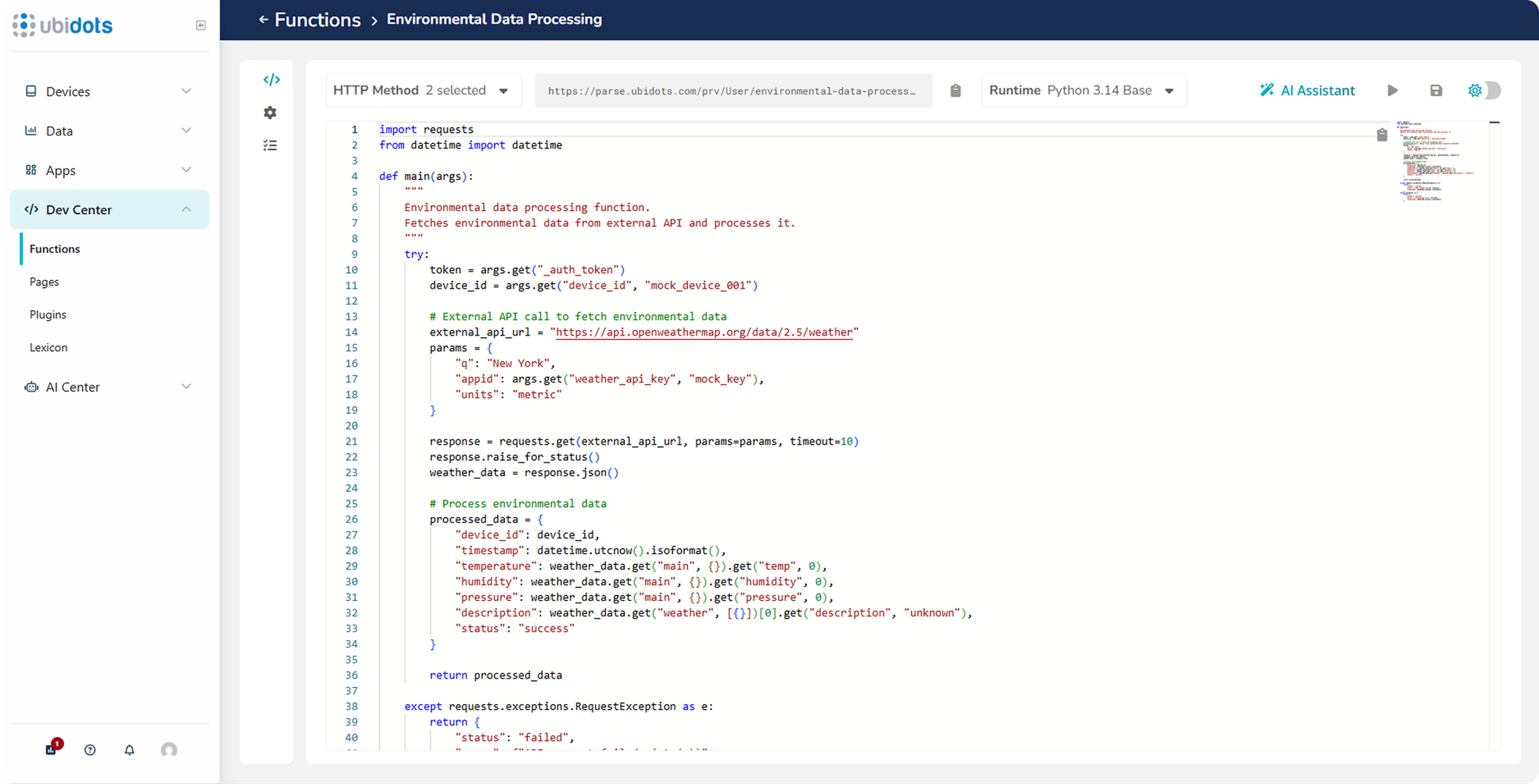
Ubidots' UbiFunctions runs Python 3.9 or 3.11 (and a NodeJS 20 runtime) in a serverless environment, with pre-installed packages including requests and httpx for external API calls, pandas and numpy for data transformation, and scipy and pyod for anomaly detection on the Full runtime tier (Enterprise license required). The complete runtime library list is published in Ubidots' developer documentation. This is the right architecture for deployments involving custom payload decoders, anomaly detection models, or connections to services that Eagle.io's single-integration catalog (S3 backup) does not cover.
4. Per-Device Pricing With Predictable Data Allocations
Both platforms have multi-axis pricing — the meaningful difference is which axes drive cost. Eagle.io's primary unit is the data source, weighted by parameter count: a station with 5 sensors is a "medium" source (≤10 parameters) consuming roughly 2.3× the capacity of a 3-parameter "small" source on the same plan. As you add parameters to existing stations, capacity consumption scales with parameter density, and a customer's costs can compound rapidly — one Eagle.io customer's trajectory: $5,000/month in 2025, approaching $20,000/month within two years.
Ubidots prices on three axes: device count, dots ingested per month, and dots consumed per month (by dashboards, APIs, and alerts). The per-device cost is fixed regardless of how many parameters that device reports — a station with 5 sensors and one with 50 sensors are billed identically per device; only the total monthly dot volume changes. For typical environmental deployments where each station reports a known set of parameters at a known interval, total monthly dots are straightforward to project from the device list and reporting frequency. The structural difference: in Eagle.io, each new parameter on a source pushes you proportionally closer to your plan's capacity ceiling; in Ubidots, parameters affect dot consumption against your monthly allocation but don't change the per-device cost.
5. Dynamic Multi-Device Dashboards
Eagle.io's dashboard architecture requires a separate configuration per site. Each site lives in a manual folder tree — one dashboard per device, set up individually. A long-term Eagle.io customer described this to us as a "Windows-like folder setup" that makes managing large fleets cumbersome.
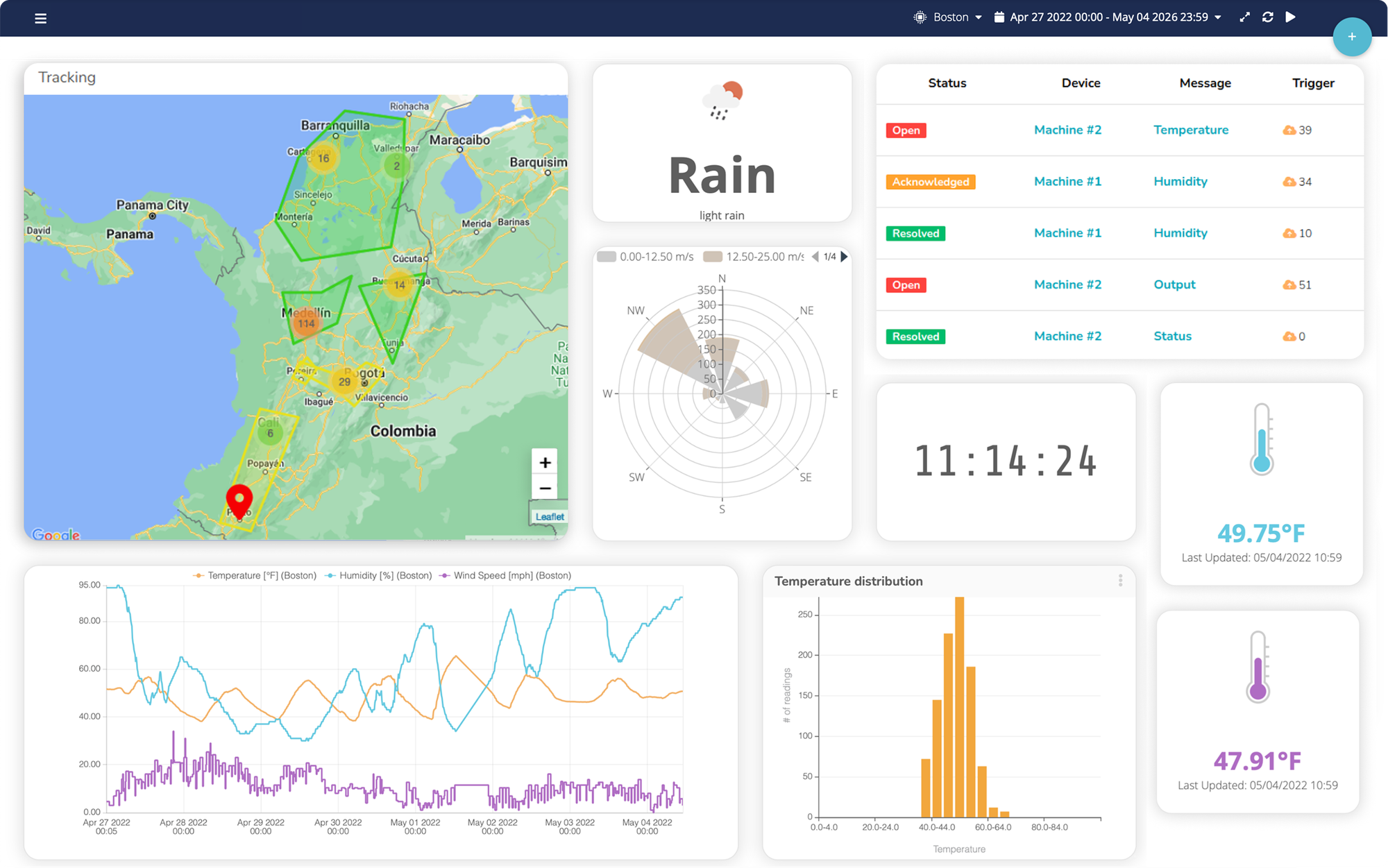
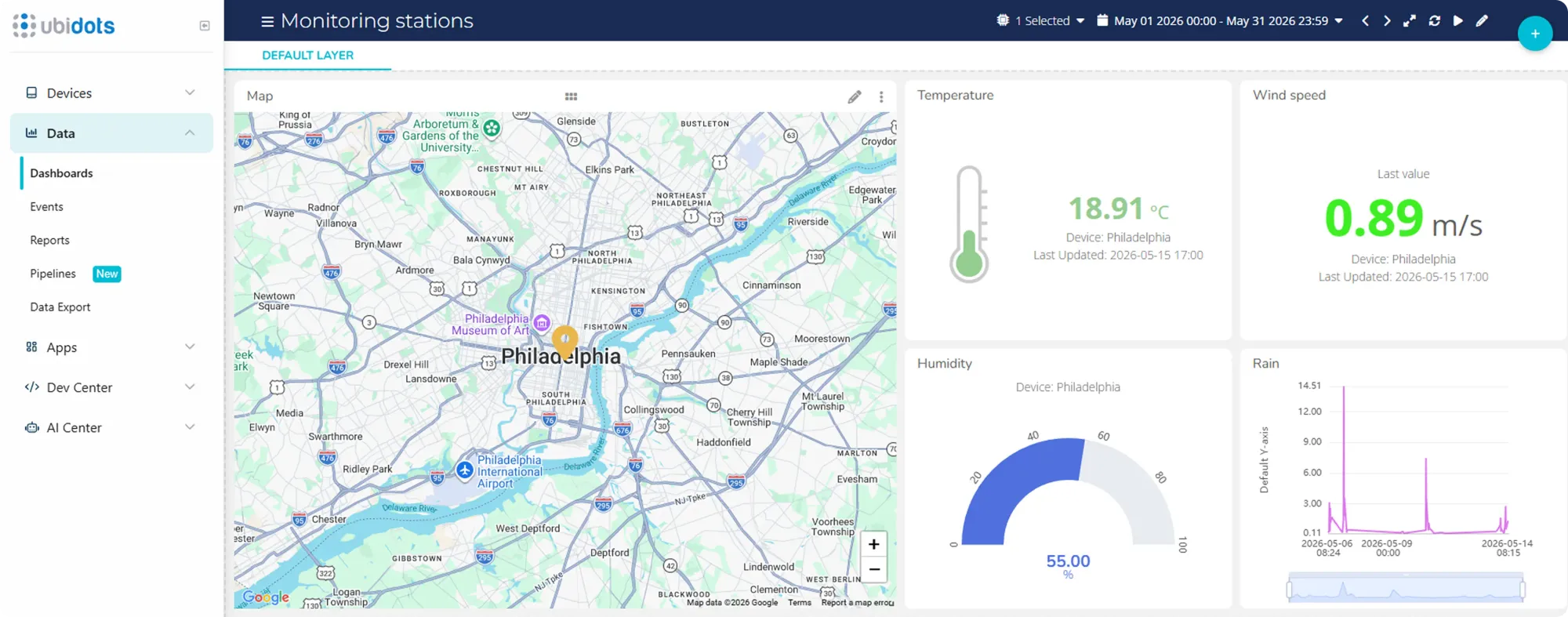
Ubidots uses a dynamic dashboard model: one dashboard template, any device. A field technician opens a map, clicks a monitoring station, and the same dashboard renders with that station's live data. No duplicate configuration, no per-site maintenance overhead. For networks with tens or hundreds of sites, this is a structural advantage, not a cosmetic difference.
Try Ubidots free for 30 days — including dynamic dashboards, UbiFunctions, and multi-tenant organizations.
Pricing Comparison: Eagle.io vs Ubidots
Eagle.io pricing is publicly available on the Bentley Systems website. An important correction to data circulating on third-party review sites: the previously listed $200/user/month figure is outdated. The current Bentley pricing model is data-source-based with unlimited users on all plans — not per-user. Plans differ on two axes: source capacity (higher tiers buy more capacity) and feature gating (basic capabilities like data editing, reporting, and single sign-on are only available on higher tiers).
Feature availability per plan, as published on Bentley's pricing page:
| Feature | Standard ($720) | Professional ($1,440) | Premium ($4,320) |
|---|---|---|---|
| Unlimited users | ✓ | ✓ | ✓ |
| Unlimited workspaces | ✓ | ✓ | ✓ |
| Dedicated subdomain | ✓ | ✓ | ✓ |
| API access | ✓ | ✓ | ✓ |
| Managed accounts | ✓ | ✓ | ✓ |
| Public dashboards | ✓ | ✓ | ✓ |
| Data editing | ✗ | ✓ | ✓ |
| Reporting | ✗ | ✓ | ✓ |
| Single sign-on (SSO) | ✗ | ✗ | ✓ |
| Volume discount | ✗ | ✗ | ✓ |
Two implications worth flagging for evaluation teams: the Standard plan at $720/month does not include data editing or report generation — capabilities most operational teams treat as table stakes. And single sign-on, a baseline IT/security requirement at most mid-sized organizations, is gated to the Premium plan at $4,320/month. There is no à la carte SSO option on lower tiers.
Sources are classified into three tiers, each consuming a fixed share of your plan's capacity budget:
- Small source — up to 3 parameters; consumes $4.32 of plan capacity
- Medium source — up to 10 parameters; consumes $10.08 of plan capacity
- Large source — up to 100 parameters; consumes $14.40 of plan capacity
| Plan | Monthly price | Indicative capacity (small / medium / large sources) | Users |
|---|---|---|---|
| Eagle.io Standard | $720/month | ~166 small, ~71 medium, or 50 large sources* | Unlimited |
| Eagle.io Professional | $1,440/month | 333 small, 142 medium, or 100 large sources (Bentley-published) | Unlimited |
| Eagle.io Premium | $4,320/month | ~1,000 small, ~428 medium, or 300 large sources* | Unlimited |
| Eagle.io additional capacity | $144/month per 10 sources | Incremental add-on | Unlimited |
*Bentley publishes the Professional plan's indicative capacity directly, plus the per-source capacity values shown above. Standard and Premium capacities here are calculated using those published values (plan price ÷ source capacity cost). Source: bentley.com/software/eagle-io-pricing.
The classification system means a deployment with many richly instrumented sites burns through plan capacity faster than one with simple single-parameter nodes. A single environmental station with temperature, humidity, pressure, conductivity, and pH (5 parameters) registers as a medium source — even though it's one physical device — and consumes more than twice the capacity of a small source.
| Plan | Monthly price | Devices | Key inclusions |
|---|---|---|---|
| Ubidots Professional | $99/month | 50 devices (+$2/device up to 1,000) | Dynamic dashboards, event logic, synthetic variables, 5 end users |
| Ubidots Industrial | Custom | 1 to thousands | All Professional features + white label, multi-tenancy, advanced widgets, custom-branded app |
| Ubidots Enterprise | Custom | 1 to thousands | All Industrial features + SSO, custom SLAs, dedicated TAM; private deployment quoted on demand |
The meaningful head-to-head is at scale: an Eagle.io Premium deployment at $4,320/month includes Email/SMS alerts, ES5.1 scripting, and source-based capacity. A comparable Ubidots deployment includes Python scripting, 30+ widget types, native multi-tenancy, white-label output, and modern notification channels. Contact Ubidots for an Industrial quote tailored to your device count.
The Bottom Line
Ubidots as an Eagle.io Alternative
Ubidots is the stronger choice when your deployment requires any of the following: multi-tenant client isolation, white-labeled output, custom Python logic, ML/AI processing, modern alert delivery (Slack, Telegram, WhatsApp), or hardware outside Eagle.io's ~20 listed device integrations. If your cost trajectory on Eagle.io is climbing and the platform's development pace feels stalled, those two signals together make a migration worth evaluating in detail.
Ubidots' dynamic dashboard model also scales more efficiently for large site networks. If you manage 20, 50, or 200 monitoring stations and currently maintain a separate Eagle.io dashboard per site, migrating to a single-template model in Ubidots removes significant configuration overhead from your ongoing operations.
Ubidots as an Eagle.io Complement
If your Eagle.io deployment is stable and covers exactly the devices listed in Eagle.io's documentation, there may be no urgency to migrate the core data collection layer. Some teams run Ubidots in parallel for the client-facing dashboard and alert layer — using Eagle.io as a data collection backend via its API while Ubidots handles visualization, multi-tenancy, and white-labeled reporting. This captures Ubidots' presentation-layer advantages without disrupting existing field hardware integrations.
Is Eagle.io Still Being Developed After the Bentley Acquisition?
Development on Eagle.io appears to have slowed materially since the August 2022 acquisition. A water and agriculture monitoring firm that has run the platform for nearly a decade told us in early 2026 that it has seen "no development for 3 years." The official documentation still marks the reports module as "pre-release" — a label that predates the acquisition by at least 14 months (a June 2021 archived snapshot of the docs already shows the pre-release warning) and has not been removed since. The scripting engine remains pinned to ECMAScript 5.1, with third-party libraries on 2018-era versions. Bentley's visible investment appears focused on iTwin IoT, which it markets as the more advanced option for customers who need to grow beyond Eagle.io's scope.
That said, Bentley has not announced Eagle.io's end-of-life. The platform continues to receive maintenance and the pricing structure was updated under Bentley. "No development" here means no significant new feature surface — not abandonment. Teams on stable deployments with supported hardware should not expect disruption in the near term. Teams counting on the platform to evolve should factor the development trajectory into their roadmap.
How Much Does Eagle.io Cost?
Eagle.io's current pricing under Bentley is data-source-based, not per-user. Standard costs $720/month, Professional $1,440/month, and Premium $4,320/month, with additional source capacity available at $144/month per 10 sources. All plans include unlimited users, unlimited workspaces, API access, and a dedicated subdomain — but several capabilities are gated to higher tiers. Data editing and report generation require Professional or Premium; single sign-on and volume discounts are Premium-only. Sources are billed by tier — small (≤3 parameters), medium (≤10 parameters), or large (≤100 parameters) — and consume $4.32, $10.08, or $14.40 of plan capacity respectively. The Professional plan ($1,440/month) maps to roughly 333 small, 142 medium, or 100 large sources. Costs scale with the number and parameter density of data sources in your deployment — a structure that is favorable for sparsely instrumented fleets but expensive for field networks with many richly instrumented sites. For reference, the previously circulated $200/user/month figure reflects outdated pricing and does not match the current Bentley billing model.
What Are the Main Limitations of Eagle.io?
Eagle.io's most significant technical constraints, sourced directly from the official documentation:
- 20,000 records/day per source — Overload Alarm threshold. Exceed it and an Overload Alarm fires. The threshold is identical across Standard, Professional, and Premium plans (confirmed on the Bentley pricing page) — a structural constraint, not a pricing artifact you can upgrade your way out of. The math is unforgiving: anything reporting faster than one record every 4 seconds will exceed the threshold within a single day.
- ECMAScript 5.1 scripting engine. No modern JavaScript syntax. Third-party libraries locked to 2018-era versions (moment.js 2.22.2, in maintenance mode since 2020). No Python, no package manager.
- Email and SMS notifications only. No Slack, Telegram, WhatsApp, webhook, or push notification channels documented in the current release.
- ~20 listed device integrations. The device configuration docs list roughly 20 named brands (Campbell Scientific, dataTaker, OTT netDL, Sigfox, and others); for any device not on that list, the docs direct you to "contact us to get support" — there is no documented self-service workflow for registering a generic HTTP or MQTT device.
- Reports are still pre-release. The docs explicitly flag the reports module as "pre-release version that is subject to change without notice" with "limited account availability."
- One documented integration: S3 backup. No native Slack, AWS IoT, Zapier, or The Things Stack connectors in the integrations documentation.
- API rate-limited to 350 requests per 5-minute window per IP. Approximately 70 requests/minute — a constraint for high-poll integrations or large dashboards with many concurrent API calls.
- Core capabilities gated to higher pricing tiers. The Standard plan ($720/month) does not include data editing or report generation. Single sign-on, a baseline requirement at most organizations with shared identity infrastructure, is only available on the Premium plan ($4,320/month) — there is no à la carte SSO option on lower tiers.
Eagle.io vs Bentley iTwin IoT: Which One Fits Your Use Case?
Eagle.io and iTwin IoT are not equivalent products. Eagle.io targets environmental and geotechnical monitoring with a curated set of field hardware integrations — it is purpose-built for water utilities, dam safety, air quality, and structural health projects that run standard data loggers. iTwin IoT is Bentley's full digital twin infrastructure platform, targeting large-scale civil and industrial programs where the monitoring layer integrates with 3D models, BIM workflows, and enterprise data pipelines.
Bentley positions the two as a natural progression: Eagle.io for straightforward environmental monitoring, iTwin IoT for programs that outgrow it. If you're an environmental monitoring firm whose requirements stop at reliable time-series collection and visualization, iTwin IoT is likely overbuilt for your use case. If your monitoring layer needs to integrate with digital twin infrastructure models and Bentley's broader engineering software stack, iTwin IoT is the direction Bentley intends for you.
Best Eagle.io Alternatives at a Glance
For teams evaluating the full market before deciding:
- Ubidots — Best for multi-tenant, white-label, or Python-extensible deployments. Per-device pricing with monthly data allocations. Strong fit for system integrators, environmental OEMs, and water/agriculture monitoring networks of any scale. See also: how Ubidots compares to Ignition.
- Rayven DynaMIX — Australian IoT platform with environmental monitoring focus; explicitly targets post-Bentley Eagle.io migration with AI/ML capabilities and bidirectional control.
- AWS IoT Core + Timestream — High-scale, infrastructure-level option. No managed dashboard layer; requires significant integration engineering.
- InfluxDB Cloud — Strong time-series database layer; requires separate visualization tooling (Grafana or similar).
- Bosch IoT Suite — Enterprise IoT platform with broad device management; better suited to industrial OEM programs than environmental monitoring networks.
Frequently Asked Questions
Is Eagle.io still independent or part of Bentley?
Eagle.io is fully part of Bentley Systems. The acquisition completed in August 2022 and the eagle.io domain now permanently redirects to bentley.com/software/eagle-io. Eagle.io operates as a sub-product within Bentley's software portfolio alongside the more advanced iTwin IoT platform.
How does Eagle.io's pricing compare to Ubidots?
Eagle.io is priced by data source: Standard at $720/month, Professional at $1,440/month, Premium at $4,320/month, with unlimited users on all plans. Sources are billed by parameter count — small (≤3 parameters), medium (≤10 parameters), or large (≤100 parameters) — each consuming a different share of plan capacity. Note that Eagle.io gates several capabilities by tier: data editing and reporting require Professional or higher, while single sign-on is Premium-only. Ubidots Professional starts at $99/month for 50 devices with monthly dot (data point) allocations; Industrial and Enterprise are custom-priced. Both platforms have multi-axis pricing, but they differ on which axes drive cost: Eagle.io's primary unit is the data source weighted by parameter count, while Ubidots' primary unit is the device with monthly dot allocations as a secondary axis. For deployments with many parameters per device at predictable reporting intervals, Ubidots' per-device structure is easier to project because parameter count doesn't push you across pricing tiers.
Can I migrate from Eagle.io to Ubidots?
Yes. Ubidots accepts data from any device that speaks HTTP, MQTT, TCP, or UDP — including the hardware brands listed in Eagle.io's device documentation, such as Campbell Scientific, dataTaker, and Sigfox. Most field hardware that currently pushes data to Eagle.io can be reconfigured to publish to Ubidots via MQTT or HTTP without hardware replacement. The migration work is primarily reconfiguration and dashboard rebuilding, not hardware swap-out.
Does Eagle.io support LoRaWAN?
Yes. Eagle.io includes LoRaWAN-compatible devices in its documented device list. Ubidots also supports LoRaWAN via MQTT and HTTP ingestion, plus native integrations with LoRa network servers including The Things Network.
Is iTwin IoT a replacement for Eagle.io?
Bentley positions iTwin IoT as an upgrade path for Eagle.io customers whose requirements grow beyond Eagle.io's scope — not a feature-for-feature replacement. iTwin IoT targets digital twin infrastructure programs; Eagle.io targets environmental and geotechnical monitoring. They serve adjacent but distinct use cases.
Who are the main Eagle.io competitors in 2026?
The main alternatives to Eagle.io for environmental and industrial monitoring are Ubidots, Rayven DynaMIX, AWS IoT Core, InfluxDB Cloud, and Aquatic Informatics AQUARIUS (for water-specific data management). Ubidots is the strongest direct competitor for teams that need multi-tenant architecture, white labeling, or Python-based custom logic.
Is Eagle.io good for water utility monitoring?
Eagle.io was built specifically for environmental and water monitoring — it has strong native support for the data loggers water utilities commonly deploy (Campbell Scientific, OTT netDL, dataTaker), and its alarm types include data quality and communications-failure conditions relevant to unattended field sites. The 20,000-record-per-day per-source threshold — identical across all three plan tiers — and the stalled development pace are the primary reasons long-term water utility customers are now evaluating alternatives.
Can Eagle.io be white-labeled?
Eagle.io does not document any white-label capability in its current technical documentation. Ubidots includes full white labeling: custom domain, custom branding, and a white-labeled mobile app — meaning your end customers interact with your brand throughout.
Does Eagle.io support multi-tenancy?
Eagle.io has a "managed accounts" feature that provides some hierarchical account structure, but the platform was not designed for the MSP or reseller use case where a single operator manages fully isolated end-customer environments under one license. Ubidots is built around native multi-tenancy with full organization isolation, separate user access, and white-labeled output per tenant.
What is the easiest Eagle.io alternative for small environmental projects?
Ubidots Professional at $99/month covers 50 devices and includes dynamic dashboards, event logic, and standard alert channels. For small environmental monitoring projects — a handful of weather stations, water level sensors, or air quality nodes — it's the most accessible entry point that scales into a multi-tenant, white-labeled deployment without switching platforms.