
Industrial Energy Monitoring Over Cellular: 5 Approaches
Five ways to backhaul an industrial energy meter over cellular, with current 2026 hardware, real deployments, and a costed twelve-point scenario.


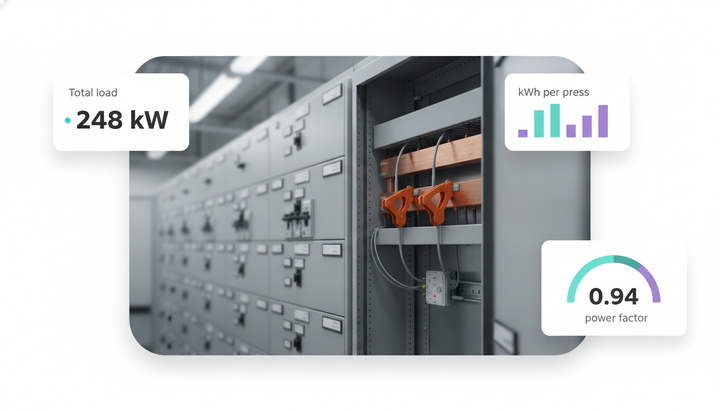
An industrial energy monitoring system over cellular has two halves: a meter or clamp that measures the circuit, and a cellular uplink that carries the reading out of the building without an IT ticket or a network drop. The measurement half is a solved problem. The uplink is the half worth deciding carefully.
In most IoT projects it is the other way round. Instrumenting the real world — getting a physical variable off a machine and into a form that can travel to the cloud — is what consumes the schedule: choosing a sensor, mounting it, calibrating it, and proving the number it produces means something. Energy is the happy exception. Current transformers, three-phase meters and metering ICs have been built at scale for decades, they carry published accuracy classes, and an electrician can install one without anyone inventing anything.
The hard part is the last hundred meters. The meter sits in a locked electrical room, often in a basement or a remote pump house, and the nearest network drop is a hundred meters and one facilities-request ticket away. That gap — accurate measurement with no path to the cloud — is why an industrial energy monitoring system so often stalls after the meter is already on the wall.
Cellular backhaul closes it, and there are five distinct ways to build it. They differ by an order of magnitude in cost per circuit, in how much disruption the install causes, and in what they can actually measure. This article compares the five, names the current 2026 hardware for each with manufacturer specifications, and ends with a costed scenario.
How to Choose a Cellular Energy Monitoring Approach
The criterion that decides this is not on any datasheet. In practice one variable drives the answer: how physically dispersed the measurement points are. Almost everything else follows from it.
Dispersed measurement points: wireless sensors to a centralizing gateway
Two situations spread the sensors out, and both point the same way — wireless energy monitoring, with clamp-on sensors reporting to one gateway.
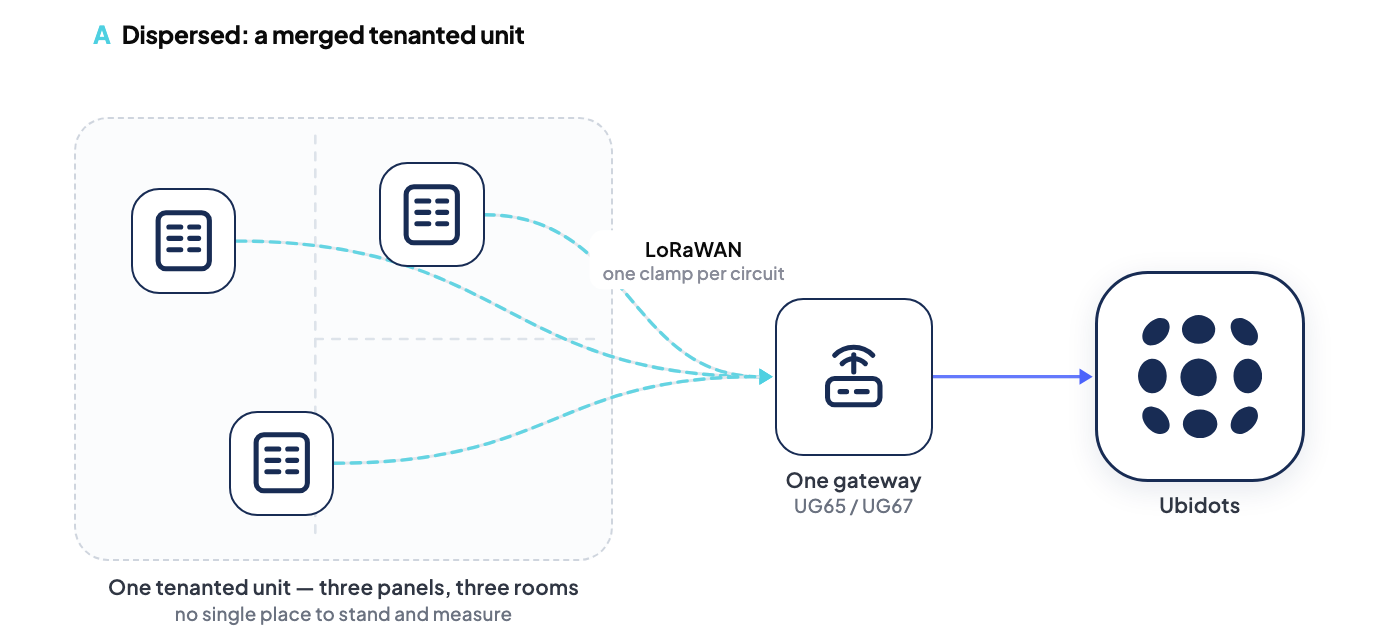
The first is a tenanted unit. An office floor or an apartment block whose electrical service has been merged and re-split over the years typically ends up with one to three panels serving the whole unit, sitting in different rooms. There is no single place to stand and measure everything. Running CT leads between panels means a contractor, a conduit and a conversation with the landlord; a clamp per circuit reporting to one gateway skips all three.
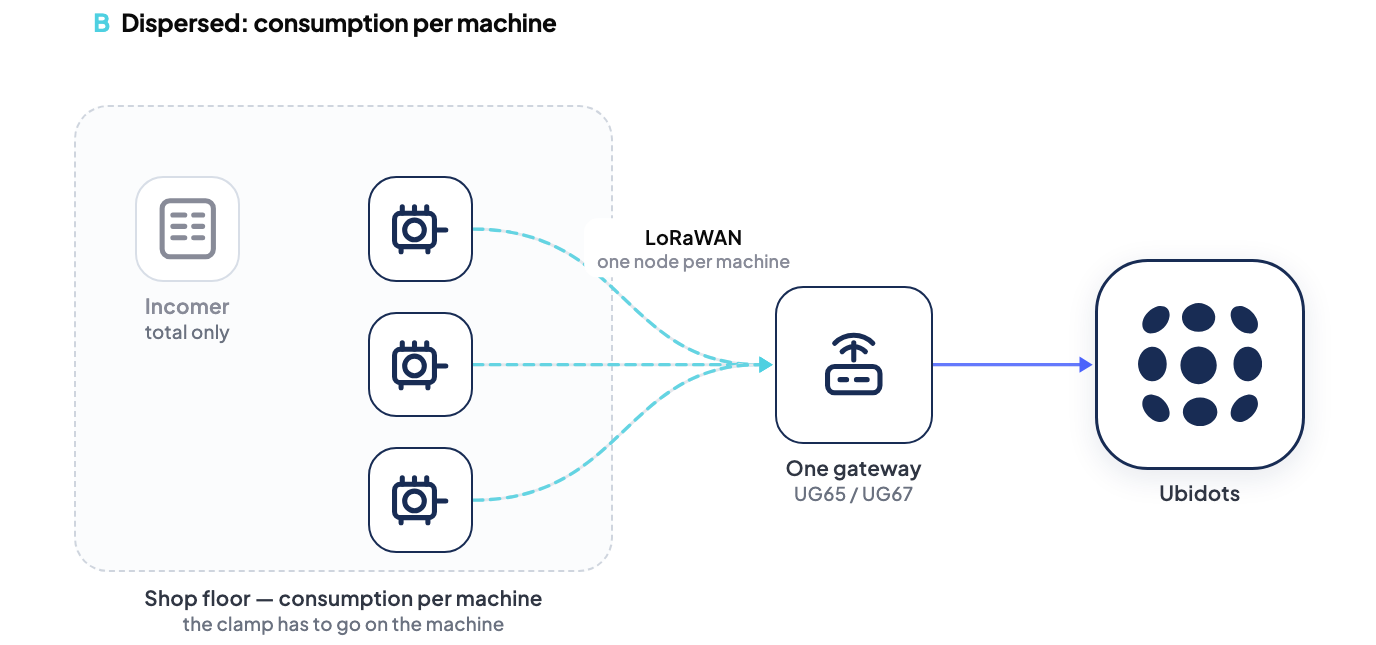
The second is an industrial site that needs consumption per machine rather than per panel. If the question is "which press is drifting," a meter at the incomer cannot answer it — the clamp has to go on the machine. Thirty machines means thirty measurement points scattered across a shop floor, and pulling thirty CT pairs back to a central meter costs more in labour and cable tray than the sensors do.
Self-powered clamps are what make this practical now in a way it wasn't a few years ago. Per the CT10x datasheet, the sensor draws its power from the conductor it measures — "self-powered, free from batteries or external wires" — so a thirty-node deployment has no battery-replacement round to schedule. That was historically the standing objection to wireless metering.
The limit nobody mentions: clamps measure current, not power
This is the single most important specification in the whole category, and it is easy to miss.
The CT10x datasheet lists exactly one electrical detection parameter: RMS current. Energy appears in the feature list as "support optional accumulated energy consumption reporting" — optional, and derived, because no voltage is sensed anywhere in the device. The CT3xx series is the same, and Milesight's own page says so plainly, directing readers who need voltage alongside current to the CTH01 instead.
So a clamp-only deployment gives you amps and a load profile. It does not give you true power, power factor, or a kWh figure anyone will accept in a billing dispute. That is a clean split in what looks like one product category:
- Load profiling, anomaly detection, "is this machine running differently than last month" — clamps are the right tool, and the cheapest one.
- Cost allocation, tenant billing, power-factor correction, harmonic work — clamps cannot do it. You need measured voltage, which means Approach 2 or 3.
Two more datasheet details worth carrying into a specification. Accuracy is ±1% above 5 Arms and ±3% at or below it. And each model has a minimum reporting current — 1.5 A on the CT101, 3 A on the CT103, 5 A on the CT105 at a one-minute interval. Size a CT105 onto a lightly loaded circuit and it will simply report nothing.
Concentrated circuits: a hub or a wired bus
The BEMS case — building energy management and tenant submetering — is the mirror image. When a building or an industrial complex brings every circuit back to one central panel or switchroom, the measurement points are already in one place — and wiring flips from being the expensive option to the cheap one.
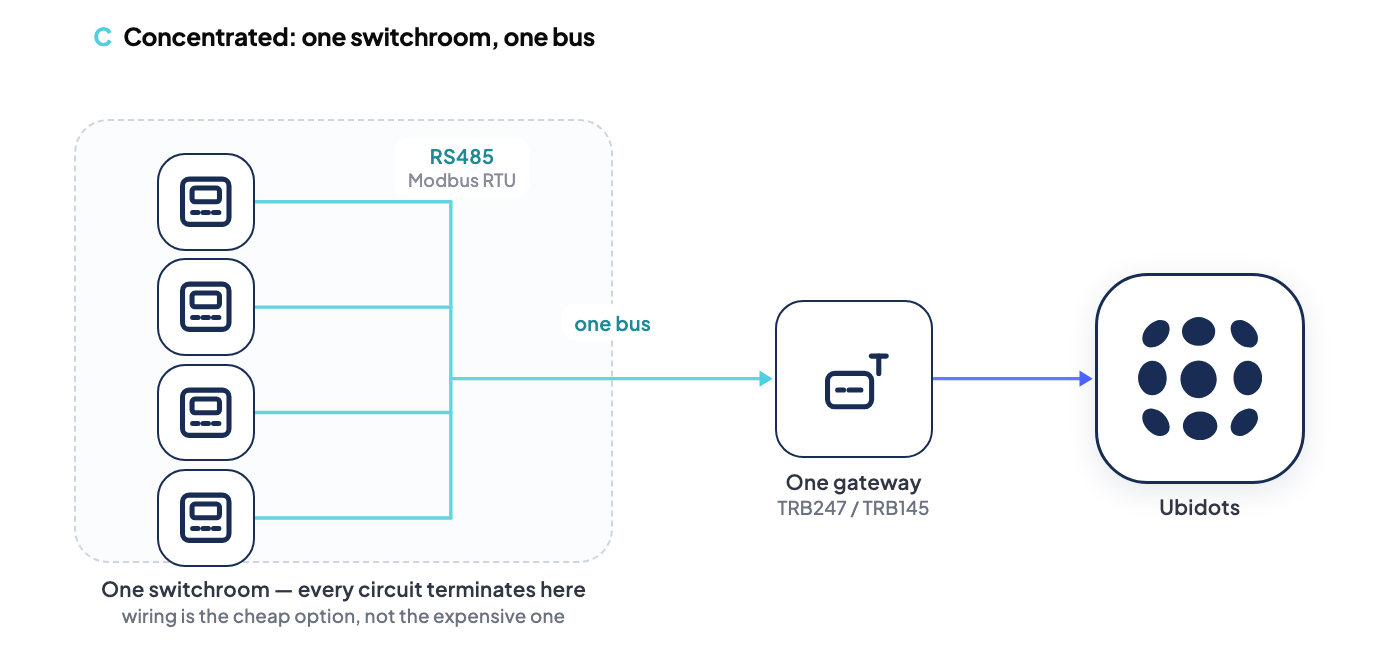
Here the classic shape of a wired power monitoring system is DIN-rail meters mounted in the panel with their CTs on the busbars, daisy-chained on a single RS485 bus and polled by one cellular gateway. Four reasons, all practical:
- Cost per circuit falls with density. One RS485 bus and one cellular subscription can cover an entire switchroom. Per-circuit radio nodes are the wrong shape when every circuit is already within arm's reach.
- There is no radio link to design. Switchrooms are steel enclosures in concrete basements. LoRaWAN penetrates well, but you can still end up specifying an external antenna and doing a coverage check before sign-off. A cable has no link budget.
- Accuracy is easier to defend. Where readings feed tenant billing or a cost-recovery claim, the meter is effectively the instrument of record, and DIN-rail meters publish accuracy classes and calibration data that clamp-on sensors generally do not.
- Fewer things to provision. Thirty LoRaWAN nodes means thirty device registrations, thirty sets of keys and a network server to run. Thirty Modbus meters on one bus means thirty slave addresses in one gateway's poll list.
What wired costs you is the install: an electrician, usually a shutdown window, and CT leads pulled to each meter. That is a one-time expense at a site that already has an electrical contractor on hand — which is precisely the BEMS situation.
There is now a third option for concentrated circuits that did not exist a few years ago: a single multi-circuit hub with a wireless uplink, which keeps the non-invasive install of the clamp approach while measuring true power. That is Approach 2 below, and for a lot of BEMS work it is the one to price first.
The secondary questions
Once dispersion has chosen the family, four questions choose the model:
- Do you need power or just current? The split above. Answer this before comparing prices, because it eliminates whole approaches.
- Can the panel be de-energized? A live retrofit forces split-core clamps and magnetic voltage probes. A planned shutdown opens up wired meters and busbar CTs.
- Is there power at the measurement point? A panel has mains. A remote pump house or a field cabinet may need solar and a battery, which rules out anything that assumes a permanent supply.
- Who owns the data? Several energy devices ship with a manufacturer cloud as the default destination, which means your historical series lives behind someone else's login and export policy. Devices that speak MQTT or Modbus natively let you route to IoT platforms like Ubidots directly and keep the raw data.
| Approach | Measures | Live install | Circuits per node | Best for |
|---|---|---|---|---|
| 1. LoRaWAN CT clamps + gateway | Current only | Yes | 1–3 per sensor | Dispersed points; load profiling |
| 2. Multi-circuit LoRaWAN hub | Full power + quality | Yes | 4 three-phase per hub | Concentrated panel, no shutdown |
| 3. Gateway + RS485 Modbus meters | Full power + quality | No | Many meters per bus | Concentrated panel, revenue-grade |
| 4. All-in-one cellular meter | Full power + quality | No | One three-phase service | A single service, fewest devices |
| 5. Custom cellular module | Whatever you design | Depends | Per device | OEMs, bespoke measurement |
Approach 1: LoRaWAN Current Transformers With a Cellular Gateway
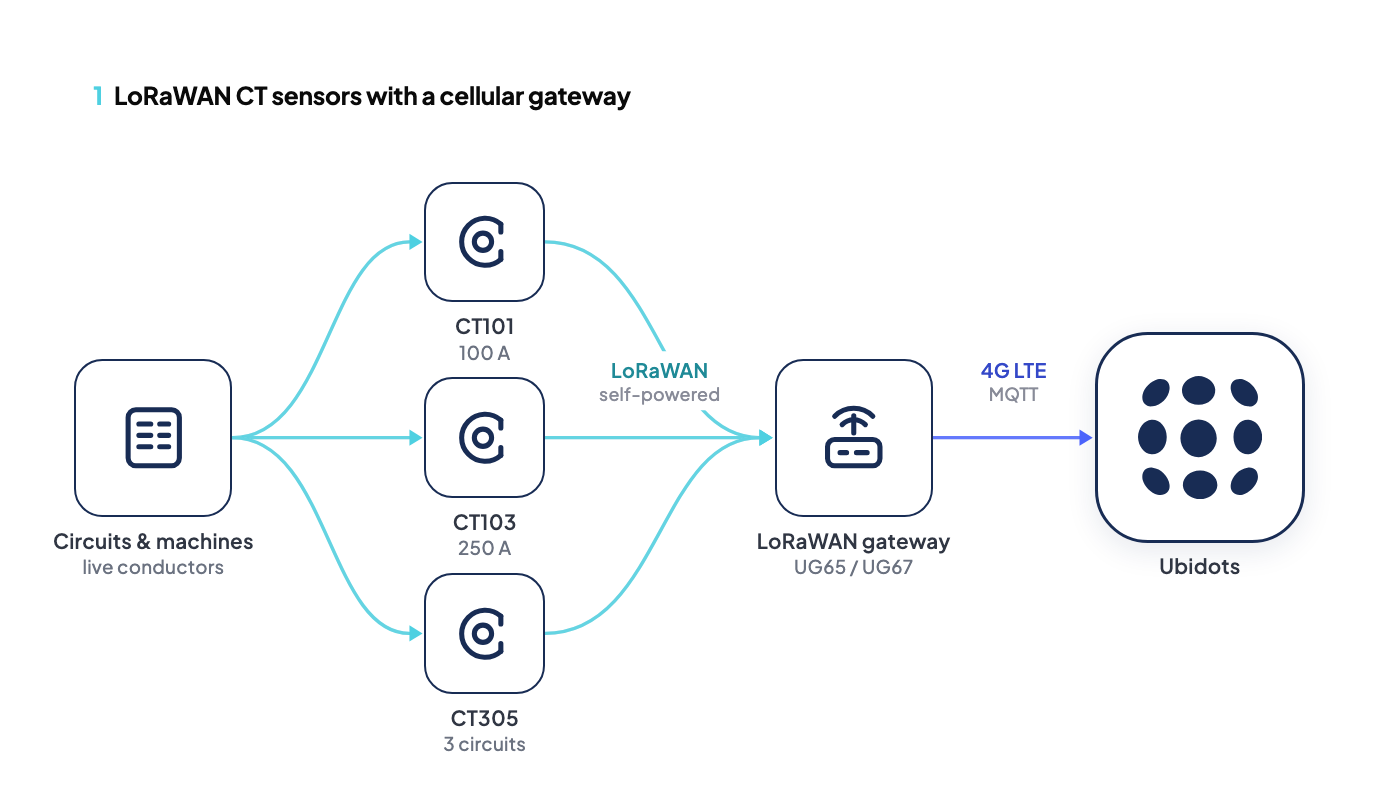
Battery-free clamp sensors measure each branch, speak LoRaWAN to a gateway somewhere in the building, and the gateway carries one cellular connection for the whole fleet.
Milesight's CT series is the reference implementation. Per the CT10x datasheet: CT101 is rated 100 Arms, CT103 250 Arms and CT105 500 Arms, all sampling at 3.3 kHz with a 1 mA resolution. The CT3xx series uses a one-to-three design — CT303 at 300 A, CT305 at 500 A, CT310 at 1000 A — measuring up to three circuits from a single node, which is what makes three-phase practical without three radios per point.
Both families install split-core around a live conductor with no de-energizing, and both are self-powered from the measured conductor with a USB-C input as backup. Both measure current only.
Choosing the Gateway
The gateway decision is mostly environmental. All four models below are 8-channel LoRaWAN gateways; what separates them is ingress protection, temperature range, and whether cellular is built in.
| Model | Rating | Temperature | Cellular | Best for |
|---|---|---|---|---|
| UG56 | IP30 | −20 to +60 °C | Optional | Indoor industrial, inside an enclosure |
| UG65 | IP65 | −40 to +70 °C | Optional | Wall or pole mount, damp environments, PoE |
| UG67 | IP67 | −40 to +70 °C | Integrated LTE Cat 4 + SIM | Outdoor, self-contained, 2000+ nodes |
| SG50 | Outdoor | — | Cellular backhaul | Remote sites with no power — solar with battery |
The UG67 is the one to reach for when the site has no Ethernet at all: it integrates an LTE Cat 4 modem and SIM slot, so it needs only power and an M2M SIM. Milesight documents the SG50 as running roughly four days without sunlight on its internal battery, which is what makes unpowered remote sites viable.
Deployed examples
Two public deployments show the shape of this approach at scale. Twin4Green used CT101 sensors across UK railway stations for LNER, feeding electrical disaggregation data into a cognitive digital twin via AWS IoT Core, alongside WS558 lighting control to establish an energy baseline before an LED retrofit. And in a set of Spanish deployments, Monolitic combined CT101 with air-quality, noise and people-counting sensors at a concert hall, where electricity is a leading operating expense.
Both are load-profiling and baselining applications, which is exactly what current-only sensors are good at.
Best for: dispersed measurement points where the question is load behaviour rather than billable energy.
Approach 2: A Multi-Circuit LoRaWAN Hub in the Panel
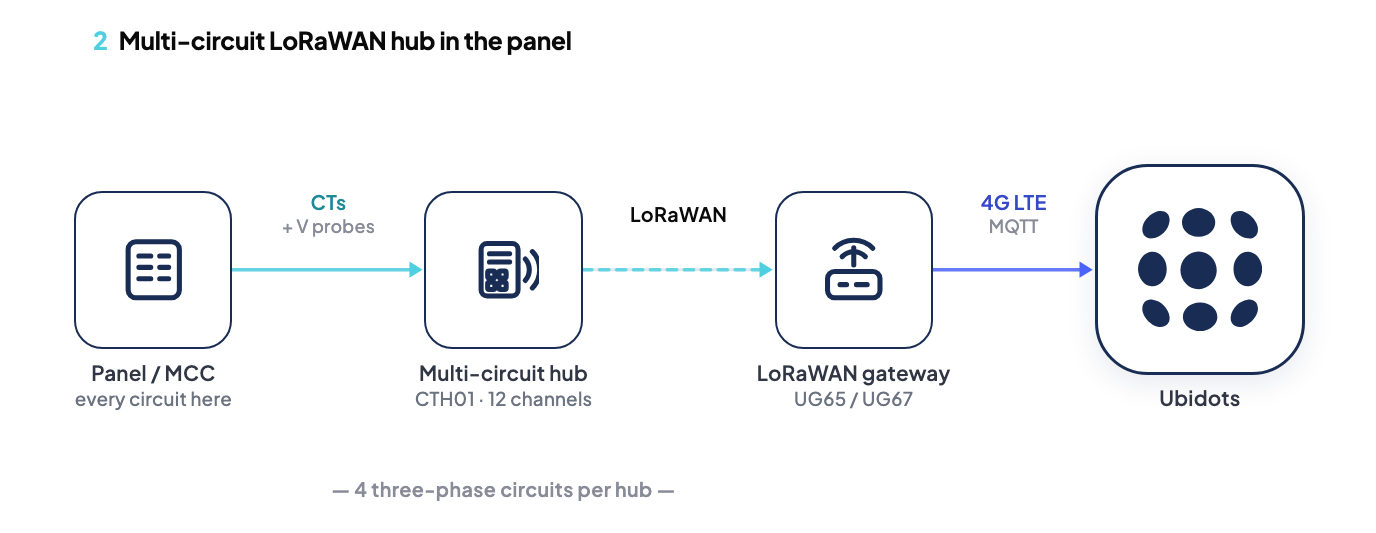
This is the approach that closes the gap the clamps leave open, and it is the newest of the five.
The Milesight CTH01 Smart Power Monitor Hub is a single DIN-rail unit with 12 current channels and 3 voltage channels — up to four three-phase or twelve single-phase circuits from one device. Per the product datasheet it samples at 8 kHz and reports RMS voltage and current, power factor, active, reactive and apparent power, imported and exported energy, voltage unbalance, and both THDv and THDi. Standard capacity is 1,000 A, extendable to 4,000 A with Rogowski coils. The unit is 49.3 × 98 × 90 mm, mounts on DIN-35 rail or magnetically, and runs on 12 V DC at 5.8 W maximum.
The install method is what makes it interesting. Current comes from split-core CTs, as with the clamps. Voltage comes from magnetic probes that snap onto the breaker screws — no terminal wiring, no wire stripping, no conductor opened. So it delivers measured voltage, and therefore true power and power quality, without the shutdown that a conventional DIN-rail meter's voltage taps normally require.
That combination is unusual: it is the only approach here that is both non-invasive to install and capable of defensible kWh. For BEMS retrofits in occupied buildings, where a shutdown window is the hardest thing to get, that is often the deciding property.
The channel density also changes the arithmetic. Twelve three-phase circuits need 36 current channels, which is three hubs — not twelve devices, and not thirty-six radios.
Milesight positions the CTH01 for commercial buildings, industrial plants, data centres and multi-tenant apartments. Unlike the CT10x, we found no independent third-party deployment write-up for it in public sources — it is a newer product, so the evidence base is vendor documentation rather than customer stories.
Best for: concentrated circuits in a building you cannot switch off, where you need real energy figures rather than a current trace.
Approach 3: A Cellular Gateway Polling RS485 Modbus Meters
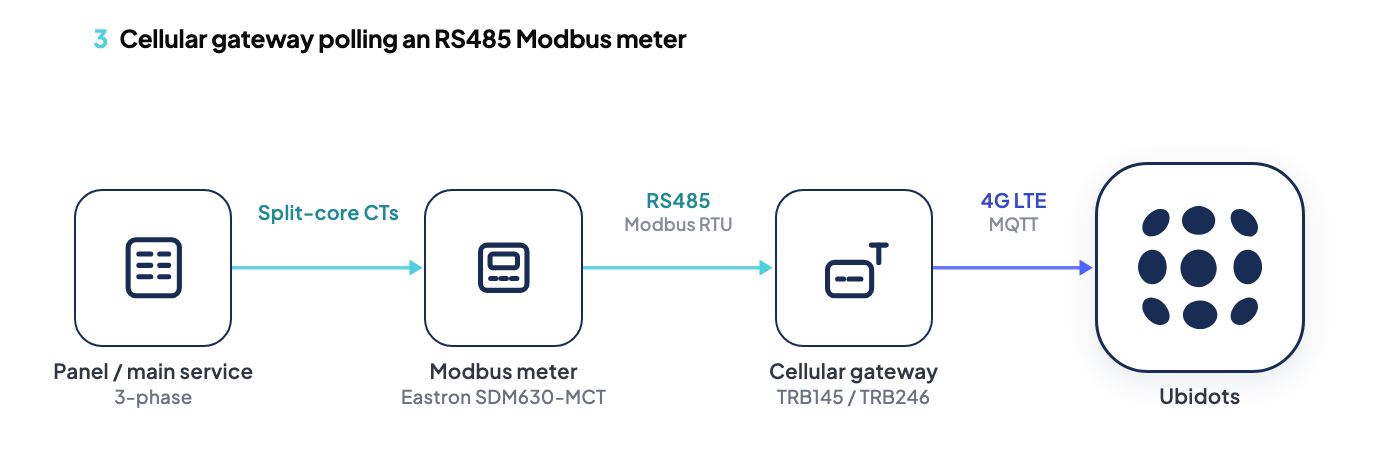
This is the path most system integrators land on for commercial energy monitoring system work, and it is the one that scales into revenue-grade metering. Dedicated meters do the measurement, a cellular IoT gateway polls them over a shared RS485 bus using Modbus RTU, and the gateway handles the uplink.
Meters purpose-built for billing accuracy tend to expose Modbus rather than a proprietary radio, and one bus can carry many meters — so a single gateway covers a whole switchroom.
Choosing the Teltonika Gateway
Model selection here has a trap and a clear winner.
The trap: the TRB245 appears throughout older integration content, but Teltonika now lists it as End of Life with published end-of-ordering and end-of-support dates. Do not specify it.
The winner, for metering specifically, is the TRB247 — and that is Teltonika's own recommendation, not ours. Their remote energy-meter monitoring use case names it directly: an LTE Cat 1 bis gateway with RS485, RS232 and Ethernet, native Modbus, DNP3 and DLMS support, dual SIM with up to seven eSIM profiles for failover in poor-signal areas, and a Data-To-Server feature that pushes readings straight to a cloud platform over MQTT or HTTPS.
- TRB247 — the metering pick. DLMS matters if you ever touch utility-grade meters.
- TRB145 — LTE Cat 1, RS485 only, ultra-compact. The right choice when one node polls one meter and nothing else. Teltonika documents it running under 5 W, solar- or battery-powered, in wind-turbine monitoring and on oil and gas pipelines.
- TRB246 — LTE Cat 4 with the fuller interface set when the site needs Ethernet and I/O alongside serial.
Milesight's UC300 (cellular) is a capable alternative when the same node also needs non-Modbus instrumentation. Per its user guide it carries RS232 plus RS485 with Modbus RTU, four digital inputs and two outputs, two 4–20 mA and two 0–10 V analog inputs, and two PT100 RTD inputs, with 4G and MQTT, TCP/UDP and SMS application modes.
RS485 to MQTT: Getting the Readings Out
On the meter side, the Eastron SDM630MCT with split-core CTs is a common specification — three-phase, Modbus RTU over RS485, MID-certified variants available, and register documentation that is widely published.
The gateway does the translation. It polls each meter's holding registers on a fixed interval and republishes the values as MQTT payloads. Running RS485 to MQTT this way keeps the meter on the protocol it was designed for while giving the cloud side a modern transport — and it means the platform never has to speak Modbus at all.
We document this path directly: connecting a Teltonika Modbus gateway to Ubidots over MQTT, and connecting an Eastron SDM230M series meter for the meter-side register mapping.
The safety hardware the tutorials leave out
A wired CT install carries components that never appear in a parts list written by someone who has not done one. Specify them:
- A CT shorting or test block on every secondary. An open CT secondary under load develops dangerous voltage. This is not optional.
- Fused voltage taps with isolation on each phase.
- Split-core CTs, so the feeder is never opened.
- A separate DIN enclosure if the existing panel has no free rail space, which is common.
This is also the honest answer to why Approach 3's hardware looks cheapest and often is not: the meter is inexpensive, and the safe installation of it is not.
Best for: concentrated circuits where a shutdown window is available and metering accuracy has to stand up to a billing dispute.
Approach 4: A Cellular DIN-Rail Meter With No Gateway At All
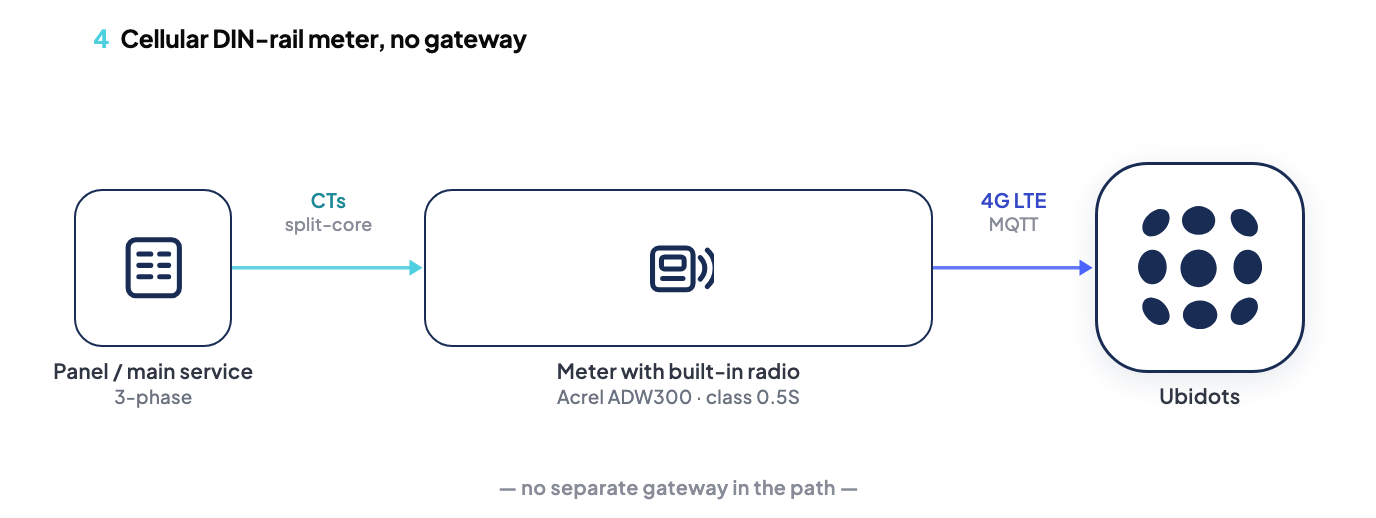
The fourth approach removes an entire class of hardware. Instead of sensors plus a gateway, the meter itself carries the radio.
The Acrel ADW300 is the clearest example. According to Acrel's installation manual it is a DIN-rail three-phase meter with a built-in wireless module supporting 4G LTE, WiFi, NB-IoT, LoRa and LoRaWAN, plus RS485 — and it speaks MQTT, Modbus-RTU and Modbus-TCP. It measures active and reactive power, current, voltage and harmonics at class 0.5S accuracy, across 45–65 Hz and AC 230/400/690 V, with support for up to 3×2000 A via Rogowski coil. It mounts on 35 mm DIN rail, operates from −40 to +70 °C, and retains 12 months of consumption history onboard. The ADW300 uses internal CTs; the ADW300W takes external ones, which is the variant for retrofit onto existing busbars.
The MQTT support is what makes it interesting for anyone who does not want a vendor cloud in the path — a 3 phase power monitor becomes a single device with no gateway to configure, power or replace.
The trade-off is not accuracy, it is multiplication. One meter measures one three-phase service, and each meter carries its own SIM. At one or two services that is the simplest architecture on this page. At twelve it means twelve cellular subscriptions, and the recurring cost overtakes the hardware saving quickly.
Best for: a single main service or a handful of panels, where minimizing device count matters more than per-branch detail.
Approach 5: A Custom Build With a Cellular Module
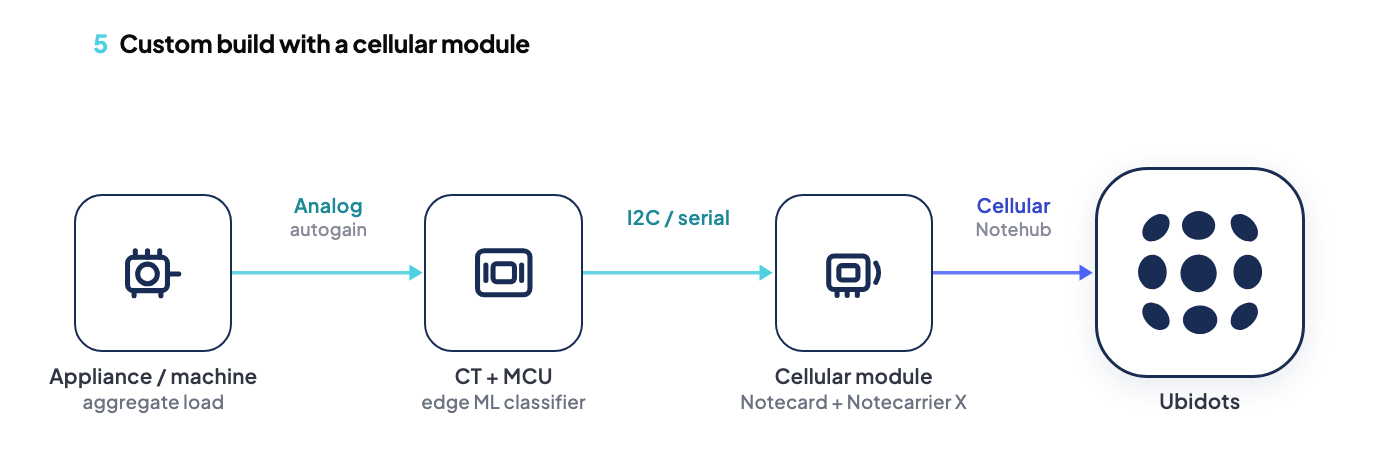
The fifth approach is for when nothing off the shelf has the right shape — an OEM embedding metering in its own product, an unusual enclosure, or a measurement the commercial meters do not expose.
Blues Notecard is the common building block. The 2026 specification note: the Notecarrier-B that appears throughout older project write-ups is discontinued, and Blues directs users to the Notecarrier X and XM. The current carrier line is CX, F, X, XM, XS, Pi and A.
On the radio side, Notecard Cellular ships in LTE Cat 1 bis, Cat 1, Cat M and NB-IoT variants across North American, EMEA and global coverage. Notecard Cell+WiFi adds WiFi failover, Notecard LoRa covers the low-power case, and new for 2026 the Notecard for Skylo combines 5G NTN satellite with NB-IoT/LTE-M cellular, WiFi and GNSS at $89 — which puts a genuinely remote pump station or substation within reach without a dedicated satellite terminal.
What this looks like commercially
Output Industries is the clearest public example of the pattern, though it is worth describing precisely: it is a manufacturing performance platform, not a pure energy deployment. The company built Busroot, a factory-floor intelligence product, on Blues connectivity — specifically Wireless for Opta, pairing the Notecard with Arduino's Opta industrial controller — so that the platform ships with its own cellular link and needs no changes to a customer's IT network. Blues reports "five to ten devices implemented and transmitting data within a day" and 20–25% productivity improvements, and cites a metal recycling company that turned energy monitoring into profit protection, without published figures.
That is the real case for Approach 5. Not that it is the cheapest way to meter a panel — it is not — but that if you are selling a monitoring product, owning the device means owning the connectivity, the enclosure and the install story. Blues also maintains an energy monitoring solutions page covering consumption analysis, energy-signature predictive maintenance and peak load management.
On the cloud side, Blues documents routing Notecard data to Ubidots by creating a General HTTP/HTTPS route in Notehub, pointing it at the device endpoint with an authentication token in the header, and applying a JSONata transformation to shape the payload. The device never talks to the platform directly — Notehub does.
Best for: OEMs and product builders, where the measurement or the form factor is the differentiator.
A Worked Scenario: Twelve Presses, One MCC
Comparing five approaches in the abstract only goes so far. Here is a concrete site.
A plastics injection-moulding plant runs twelve presses, each on its own three-phase feeder rated up to 250 A, all fed from a single MCC in one switchroom. Energy is a top-three variable cost — barrel heaters and hydraulic pumps — and the number the plant manager wants is kWh per thousand parts, per press, so that a drifting machine shows up as a cost before it shows up as a breakdown.
This scenario is worth working through because it inverts the rule this article just spent two thousand words establishing. The presses are physically dispersed across a shop floor — the textbook case for clamps on machines. But they are electrically concentrated: every press has a dedicated feeder terminating in one switchroom. Per-machine data is therefore available without going anywhere near a machine.
That single fact removes the main argument for the dispersed approach, and it is worth checking on any site before specifying hardware. Ask for the single-line diagram before you ask for a quote.
Hardware cost, twelve three-phase points
Twelve three-phase points means 36 current channels, and that number drives everything below. Prices are indicative US distributor list prices, sourced September 2026; they exclude installation entirely, and regional pricing varies.
| Approach | Sensing | Uplink | Hardware total | SIMs |
|---|---|---|---|---|
| 1. LoRaWAN clamps | 12 × CT303 @ $170 = $2,040 | 1 × UG65 @ $467.50 | ≈ $2,508 | 1 |
| 2. Multi-circuit hub | 3 × CTH01 @ $500 = $1,500 36 × 300 A CT @ $75 = $2,700 | 1 × UG65 @ $467.50 | ≈ $4,668 | 1 |
| 3. RS485 Modbus meters | 12 × SDM630MCT ≈ $85 = $1,020 + 36 CTs, shorting blocks, fused taps | 1 × TRB247 @ $194 | ≈ $1,214 + CTs and safety hardware | 1 |
| 4. All-in-one cellular meters | 12 × ADW300 — no published list price | built in | Quote via distribution | 12 |
| 5. Custom module | 12 × (Notecard $58.83 + Notecarrier X $10) = $826 | built in | ≈ $826 + engineering | 12 |
Sources: Milesight CT, gateway and UC300 prices from MCCI; CTH01 and its RCT-RJ11 current transformers from Choovio; TRB247 from NTS Direct; Notecard and Notecarrier from the Blues shop; SDM630MCT street price for the direct-connect V2 — the MCT variant differs and needs a real quote. Teltonika and Acrel do not publish list prices, which is why one row reads "quote via distribution" — that device class is not bought off a price list.
Reading the table
The cheapest row is not the answer, and neither is the most expensive.
Approach 1 is disqualified on capability, not price. At roughly $2,500 it is mid-field, but CT303 clamps measure current only. The requirement is kWh per thousand parts. Current-only sensors cannot produce it.
Approach 3 has the lowest hardware cost and the highest total cost. Twelve meters and a gateway come to about $1,200, but the row is honestly incomplete: 36 split-core CTs, a shorting block per secondary, fused voltage taps per phase and probably a separate DIN enclosure all sit on top, and then a licensed electrician installs it during a shutdown window that a moulding plant does not want to give you. It remains the right answer if the readings will ever be argued about commercially.
Approach 2 is the most expensive hardware and probably the correct specification here. About $4,700 buys three hubs, 36 CTs and a gateway — and it is the only line in the table that delivers true power and power quality from a live install. No shutdown, no CT secondaries to make safe, no landlord conversation. On a plant where downtime is measured in lost cycles, that is worth more than the $3,500 difference.
Approach 4 fails on recurring cost, not capital. Twelve meters means twelve SIMs. Even at a low per-SIM monthly rate, twelve subscriptions running for the life of the installation will exceed the hardware gap, and each one is a separate thing to notice when it stops reporting.
Approach 5 is not a purchase, it is a project. The bill of materials is the cheapest on the page at about $800, and it is the most misleading number in the table: twelve nodes of custom firmware, enclosure design, CT selection and calibration is an engineering programme. That is entirely rational if you are Output Industries and metering is your product. It is not rational to instrument one plant.
The general lesson holds beyond this scenario. Hardware cost is the smallest term in the equation and the only one anyone puts in a spreadsheet. Install disruption, SIM count and whether the device can measure what you actually promised are what decide the outcome.
Getting the Data Into a Monitoring Platform
All five approaches converge on the same question, and it is the one that decides whether remote energy monitoring actually works: how does the reading reach a dashboard? Three transports cover the field.
MQTT — The Default for Gateways and Meters
MQTT is the right choice whenever the device supports it, which includes the ADW300, the UC300 and the Teltonika TRB gateways. The device publishes to a broker on a topic and the platform subscribes. It is efficient over cellular, handles intermittent links, and does not require the device to hold a connection open the way HTTP polling does.
LoRaWAN Gateway Over MQTT
Approaches 1 and 2 have an extra hop: sensors speak LoRaWAN to the gateway, and the gateway forwards to a network server. From there, a LoRaWAN MQTT gateway configuration bridges to the platform. There are two common shapes — the gateway publishing directly over MQTT, or a network server such as The Things Stack sitting in the middle.
We document both: connecting a Milesight gateway to Ubidots over MQTT for the direct path, and connecting Milesight sensors via The Things Industries when a network server is already in place.
HTTP and Cloud-to-Cloud Routing
Approach 5 typically routes cloud-to-cloud, as the Notehub route above does. The device talks to the vendor's cloud, and the vendor's cloud talks to yours — which is convenient, and worth confirming you can export from.
Which Approach Should You Choose?
Answer two questions in order, and the field narrows to one or two options.
First: do you need power, or just current? If a load profile answers your question, clamps are the cheapest tool and Approach 1 is likely the answer. If you need kWh anyone will accept, or power factor, or harmonics, Approach 1 is out before price enters the conversation.
Second: are the circuits dispersed or concentrated? Dispersed — several panels in a tenanted unit, or a genuine need to clamp each machine — points to Approach 1 with a shared gateway. Concentrated in one panel or switchroom points to Approach 2 if you cannot take a shutdown, and Approach 3 if you can and the numbers must be defensible. A single three-phase service with no appetite for a gateway points to Approach 4. And if you are building a product rather than instrumenting a site, Approach 5.
One decision cuts across all five: confirm the device can publish to a broker or endpoint you control before you buy it. Hardware that only talks to a manufacturer cloud will meet your accuracy spec and still fail your data-retention requirement two years later.
Start a free Ubidots trial and build the dashboards for whichever approach fits your site.
Frequently Asked Questions
Do LoRaWAN current transformers measure kWh?
Not reliably. The Milesight CT10x datasheet lists RMS current as its only detection parameter and describes accumulated energy reporting as optional, because the device senses no voltage. You get amps and a load profile. For measured kWh, power factor or harmonics you need a device with voltage inputs, such as the CTH01 or a DIN-rail meter.
Should I use wireless sensors or a wired meter for energy monitoring?
It depends on how dispersed the measurement points are, not on the size of the site. If circuits are spread across several panels or you need consumption per machine, wireless clamps reporting to one gateway cost less to install. If every circuit terminates in one central panel, either a multi-circuit hub or wired DIN-rail meters on a shared RS485 bus will cost less per circuit.
How many circuits can one energy monitoring hub handle?
The Milesight CTH01 handles 12 current channels and 3 voltage channels — up to four three-phase or twelve single-phase circuits per unit. On an RS485 bus, one gateway can poll many separate meters in sequence, so a single cellular connection covers a whole switchroom either way.
Can I install energy monitoring without shutting down the panel?
Yes. Split-core current transformers clamp around a live conductor, and the CTH01 adds magnetic voltage probes that attach to breaker screws without terminal wiring — so measured power is now possible on a live install. Conventional DIN-rail meters with wired voltage taps generally do need a shutdown.
Is the Teltonika TRB245 still available?
No. Teltonika lists the TRB245 as End of Life with published end-of-ordering and end-of-support dates. For energy metering Teltonika's own use case recommends the TRB247, which adds native DLMS alongside Modbus and DNP3. For a single RS485 meter the compact TRB145 is sufficient.
What is the difference between RS485 and MQTT for energy meters?
RS485 is the physical wiring standard the meter uses locally, usually carrying Modbus RTU. MQTT is the messaging protocol used to send data over the internet. They operate at different layers — a gateway typically polls the meter over RS485 and republishes those readings as MQTT to the cloud.
What accuracy class do I need for energy monitoring?
Class 0.5S is the common specification for commercial and industrial sub-metering, and is what the Acrel ADW300 datasheet cites. If readings will be used for tenant billing or a cost-recovery dispute, confirm the accuracy class against your local metrology requirements before specifying.
Why is a CT shorting block necessary?
An open current-transformer secondary under load develops dangerous voltage across its terminals. A shorting or test block on every secondary lets the circuit be worked on safely and is standard practice in any professional CT installation, even though it rarely appears in online tutorials.
Which Blues Notecarrier replaces the Notecarrier-B?
Blues directs Notecarrier-B users to the Notecarrier X and Notecarrier XM. The B is discontinued but still supported for existing units, so older project write-ups referencing it remain readable — the hardware just is not orderable.
How do I get meter data into a dashboard without using the manufacturer's cloud?
Choose hardware that speaks MQTT, Modbus or HTTP to an endpoint you specify. Devices such as the Acrel ADW300, Milesight UC300 and the Teltonika TRB series let you point the uplink at your own broker or platform, which keeps the raw time series under your control rather than behind a vendor login.
How much does an industrial energy monitoring system cost?
Hardware for twelve three-phase measurement points ranges from roughly $800 to $4,700 depending on the approach, per the costed scenario above — and the all-in-one cellular meter option has no published list price at all. Hardware is also the smallest term in the total. Installation labour, shutdown windows and per-device SIM subscriptions usually exceed it: the approach with the cheapest bill of materials, RS485 Modbus meters on a wired bus, carries the highest install cost.
What is the difference between energy monitoring and energy management?
Energy monitoring is the measurement layer: the meters, sensors and uplink that get readings to a platform. Energy management is what you do with them — baselining, cost allocation, tenant billing and load shedding. Every approach in this article is a monitoring decision, and the management layer sits above it, constrained by whether the hardware measures current only or true power.