Your brand, end to end
Your domain, logo, colours and login on the web, and your name on the mobile app. Clients never see ours.
- Custom domain and login
- Branded web and mobile apps
- Your email sender for reports

You own the application; we keep everything underneath it running. We build the monitoring and analytics platform you sell to your clients: electricity, gas, water, solar, storage and EV charging, with dashboards for each client and AI assistants under your name. You start from a working energy application, not an empty repository.
Load Profile Report
Site 4 · hour × weekday · average kW · last 4 weeks
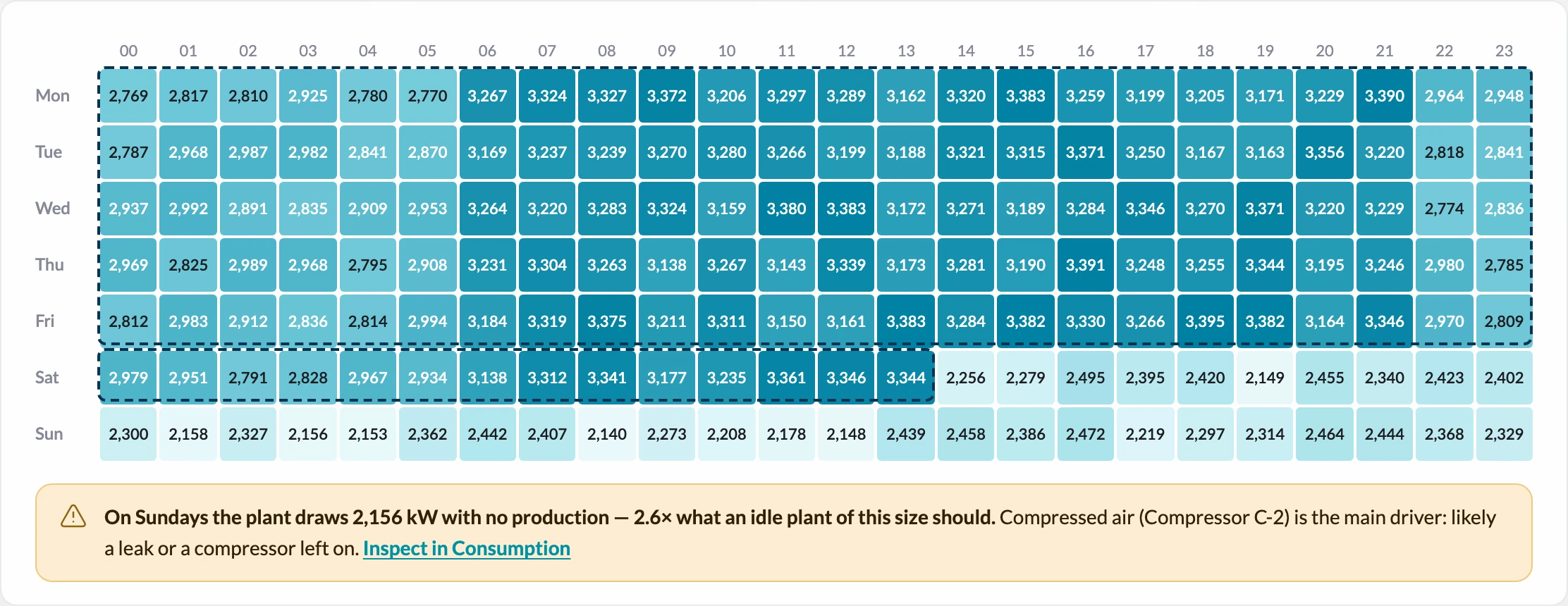
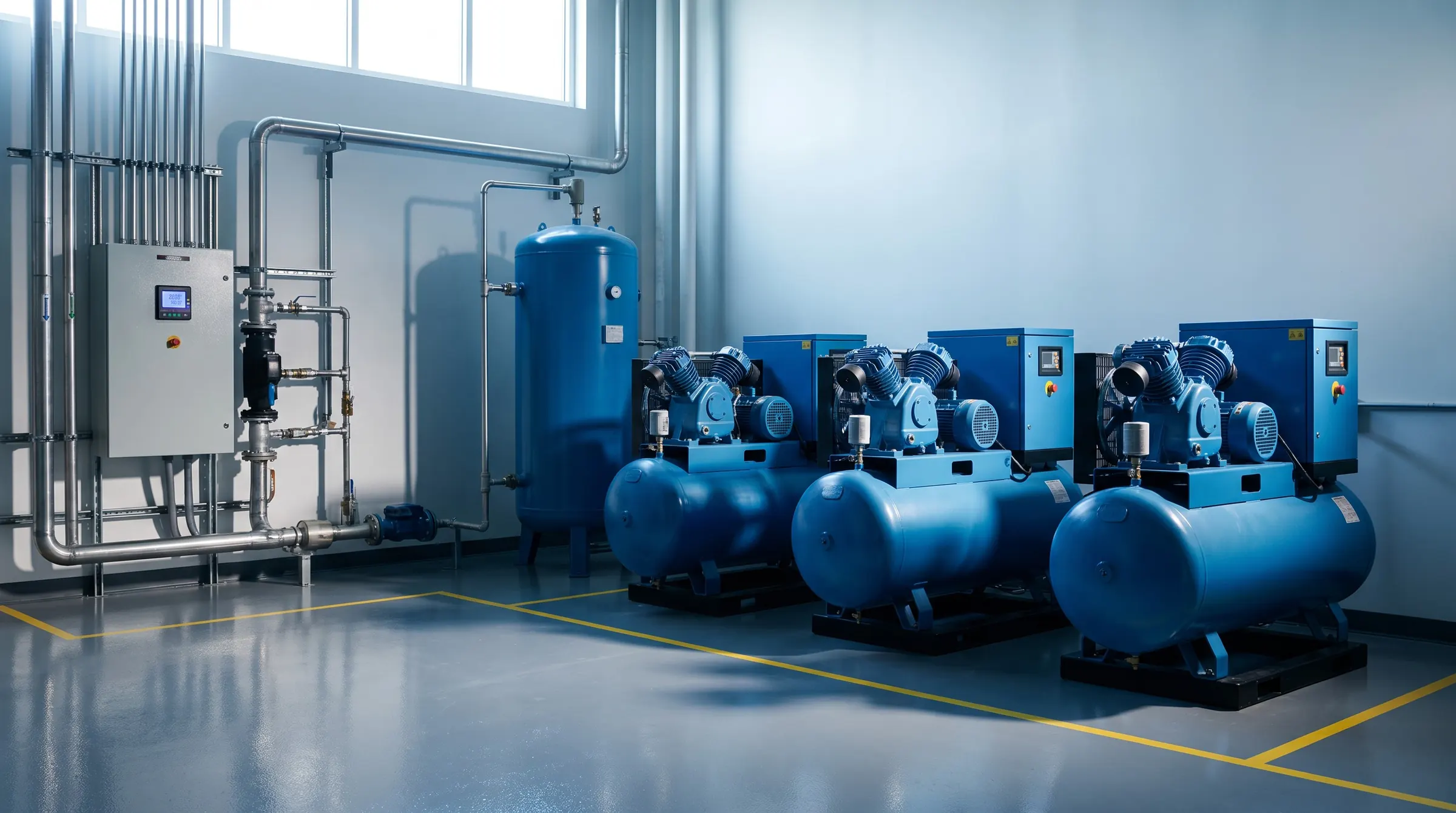
Site 4 drew 2.8× its idle baseline all weekend. Compressor C-2 is the likely cause, so I sent the trend to maintenance.
You pay for the part your clients see. Everything underneath is already built, in production and under support.
Ranges from Ubidots engagements and in-house estimates for comparable platforms. Your number depends on scope; we put a range on it in the first call.
Every client gets an application that looks like yours and fits them. Your team runs all of them from one place.
Your domain, logo, colours and login on the web, and your name on the mobile app. Clients never see ours.
Each client is its own organization with its own users and roles. Your team sees every client; each client sees only its own sites.
Overview, consumption, load profile, before/after comparisons, budgets and CO₂e, built from blocks each client can adjust without code.
Electricity, gas, water, solar, storage and EV charging in one data model. Sites without telemetry send readings by photo on WhatsApp.
Utility bills arrive by email, are read automatically and are checked against the meters before they count. Cost is estimated from the meters until the bill arrives.
Agents that answer clients' questions from live data, triage alarms and chase missing data, on WhatsApp and the web, branded as yours.
The Energy Efficiency template is a complete application: meters and bills in one model, the views energy and finance teams use, and AI agents on top. Your project adds your brand, your clients and your rules.
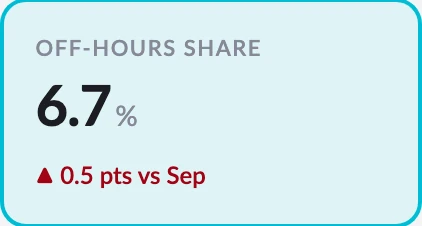
Consumption, cost against budget, off-hours waste and CO₂e, with how many meters each number comes from.
Monthly Energy Performance Report
All sites · October 2026 · vs September

October reports are out: 12 clients, each with its own numbers, under your logo.
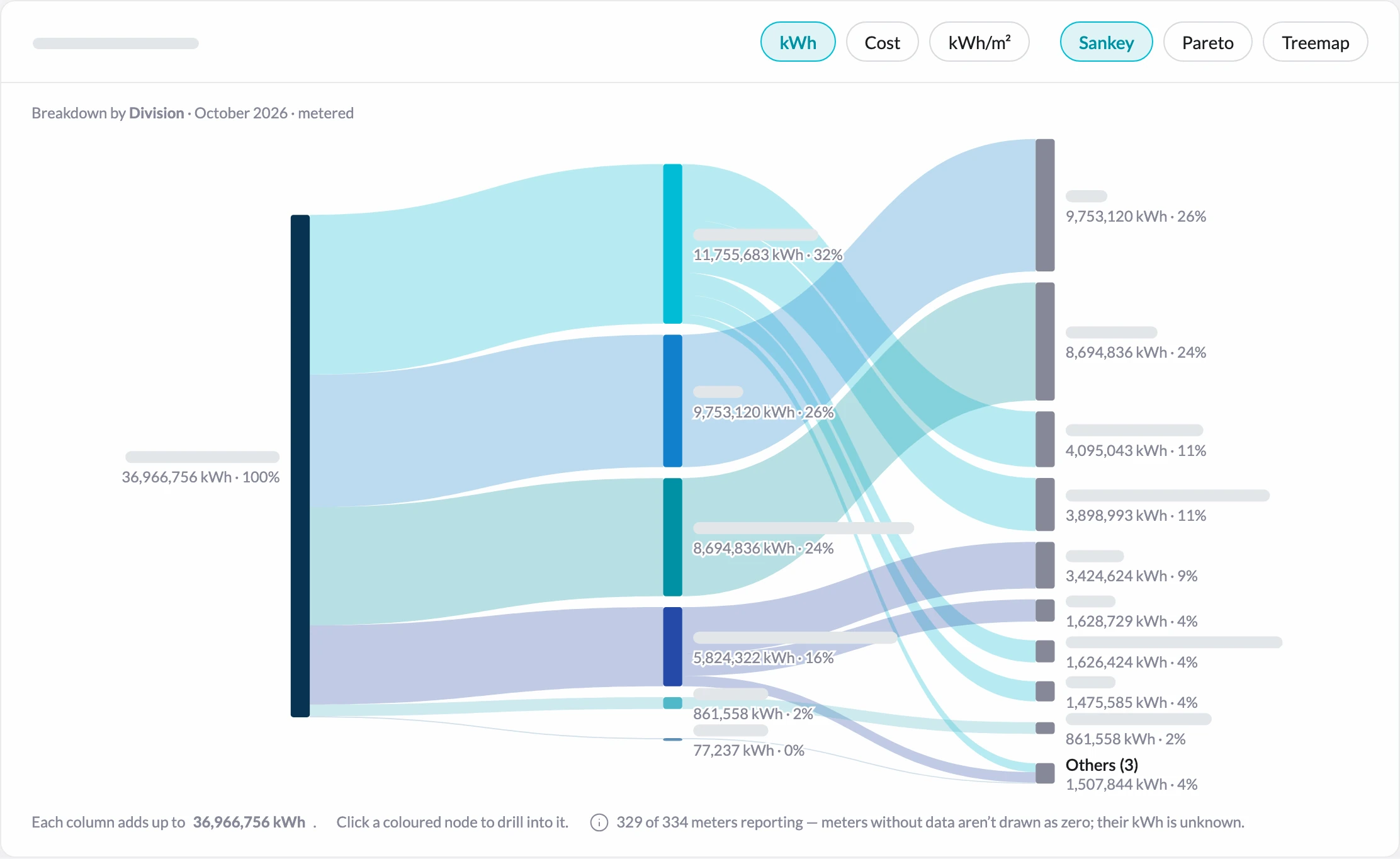
Drill from the whole client down to a single meter: by business unit, country, site, system.
Energy Consumption Breakdown
Whole group › business units › companies · October 2026 · kWh
Hour by weekday, with operating hours drawn in. A plant running all Sunday stands out.
Load Profile Report
Site 4 · hour × weekday · average kW · last 4 weeks
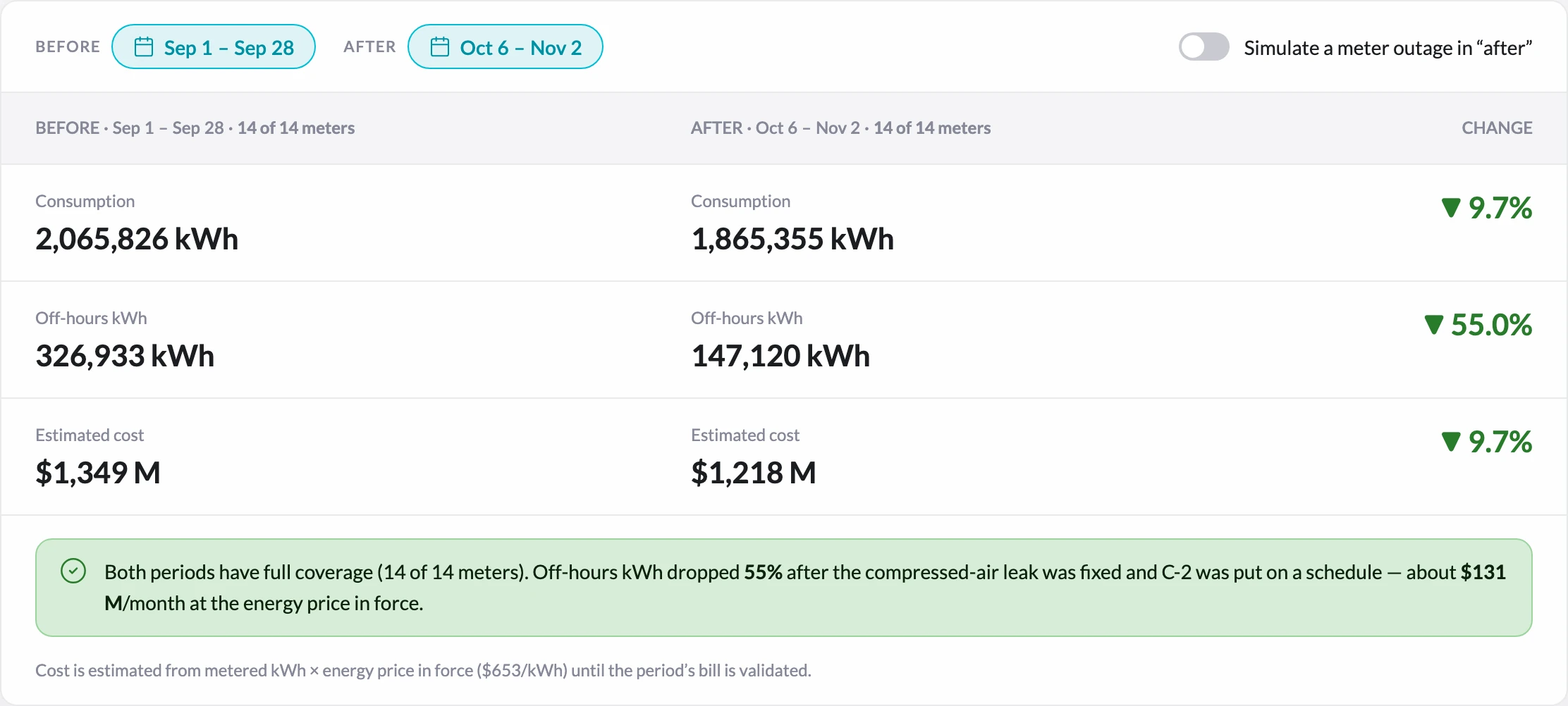
Before and after a fix, with meter coverage stated for each period.
Savings Verification Report
Site 4 · before and after the compressed-air leak repair
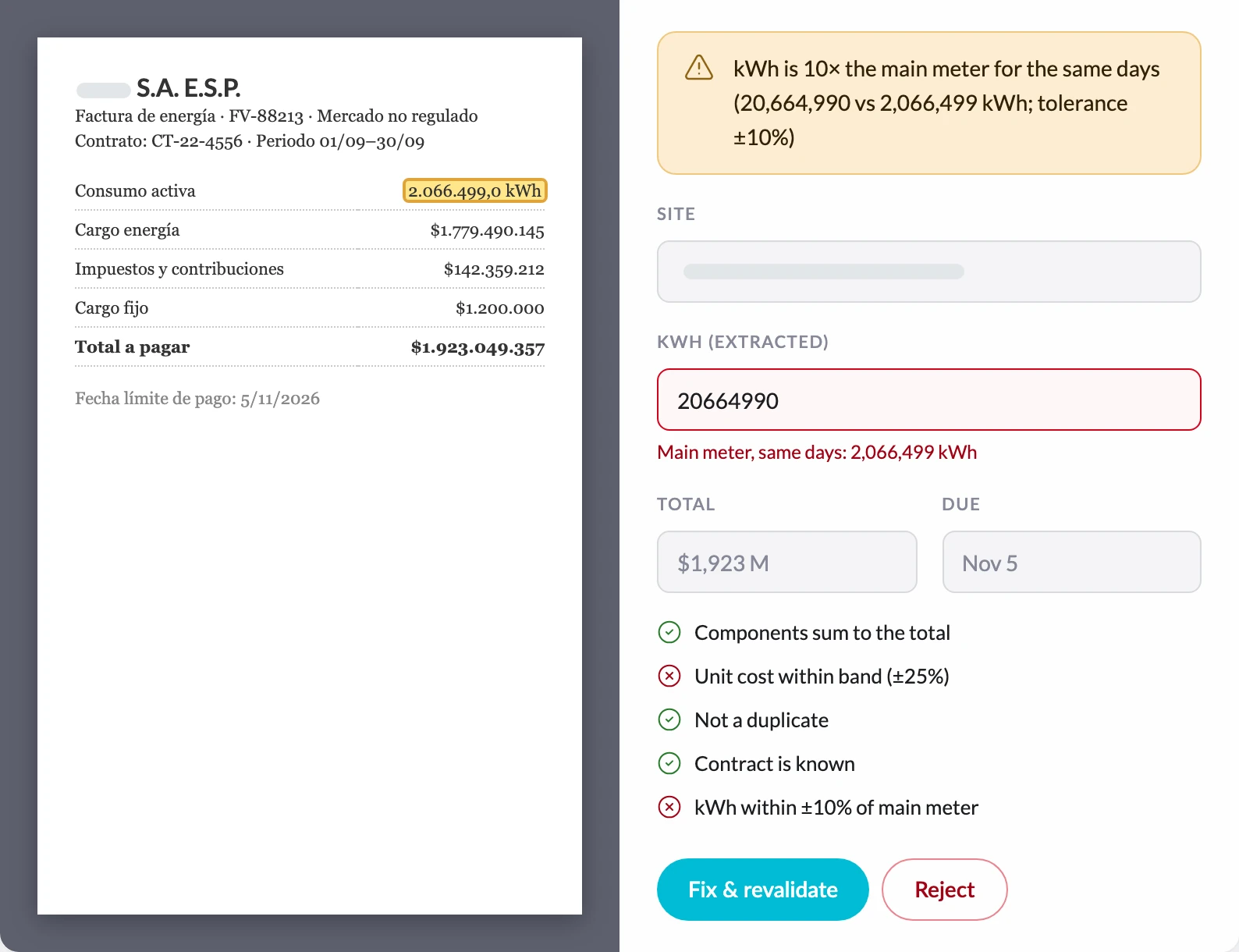
Bills read from email and checked against the meter. One that doesn't match waits for review, and never reaches a chart.

Utility Bill Audit
Bill FV-88213 · read from email · checked against the main meter
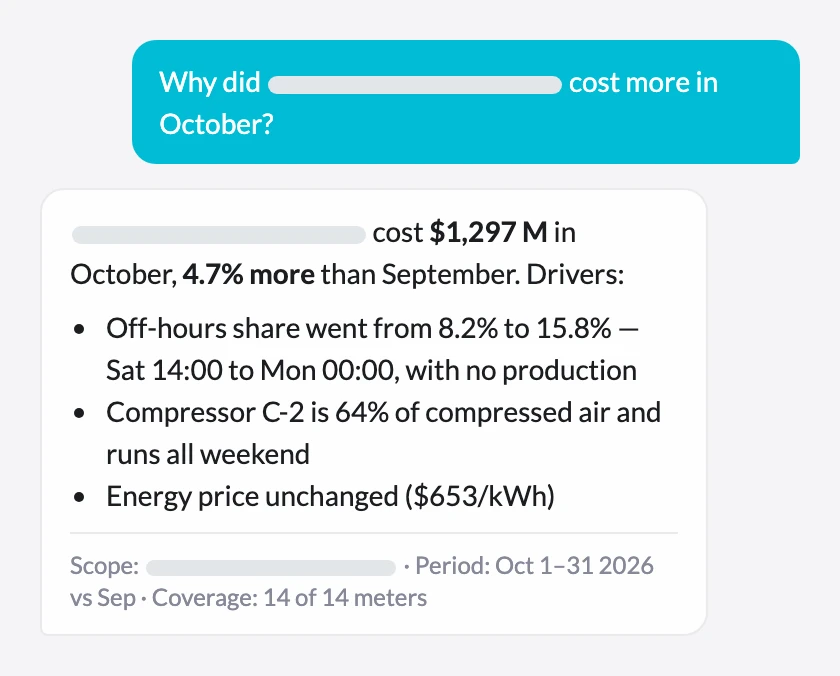
"Why did this site cost more?" Answered from live data, with scope, period and coverage.

AI Energy Analyst
Answers from each client's live data
A site manager sees one site; your team sees every client.
Site Energy Report
Plant manager view · one site


Your clients' assets already report somewhere: meters, inverters, battery systems, chargers, or a vendor cloud. We connect what is there, or specify what is missing. Hardware is specified, not supplied.
Meters and power analysers through an edge gateway (Modbus, MQTT), or pulse and LoRaWAN meters in the field.
Inverters and dataloggers, or the inverter vendor's cloud by API.
BESS controllers and energy management systems, through a gateway or by API.
Charge-point management platforms, connected by API.
Periodic readings typed in or sent as a photo on WhatsApp, checked before they count.
Utility bills by email, and your ERP or billing system by API or webhook, scoped as its own work package.
Generic AI tools have no telemetry. Energy platforms have no agents. Here they're the same product, so an agent can answer your client's question from their own meters and bills, and act on it.
A client asks "why did this site cost more in October?" The agent answers from live KPIs, with the drivers, scope, period and coverage.
An alarm opens. The agent checks operating hours, holidays, meter health and history, then tells the site manager whether it's real.
A daily digest of meters that stopped reporting, bills not received and bills due, with one incident per issue.
On WhatsApp and the web, under your name. Agents never compute a number no tool returned, and never touch equipment.
Active Alarms
Open now · by severity
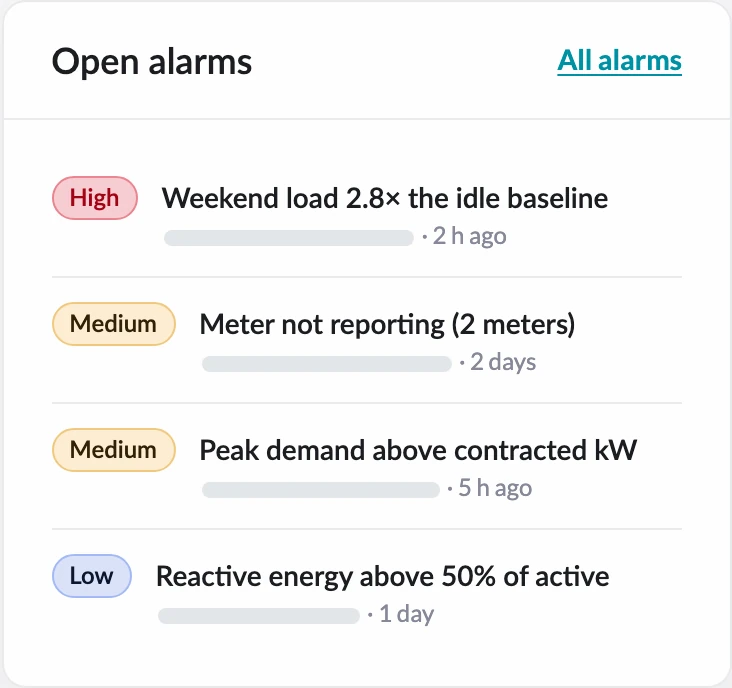
The weekend-load alarm at Site 4 is real: no production was scheduled and Compressor C-2 ran all weekend. I opened an incident and assigned the site manager.
Most of an energy platform has nothing to do with energy. It is ingestion, storage, logins, roles, alerting and the reports clients ask for, and whoever builds it has to maintain it forever.
Before anyone builds the client portal you want to sell, a team builds, and then maintains, the whole stack underneath it.
The work begins at your data model and your interface, because everything below that line already exists and is under support.
Every building block of the platform is made for AI agents to work with, so our engineers' agents build on it directly. That compresses the build. The specification, code review and QA stay with senior engineers, and are why the result is maintainable.
Typical effort split of a custom build. The cyan block is where the time goes away; the rest is the human quality floor.
A platform you build yourself is worth the most on the day it ships. After that, someone owns its uptime, its security patches and every dependency in it — permanently.
Here, everything above the line is yours: the data model, the screens, the brand. Everything below it is ours to run, under support, and it keeps improving underneath you without landing on your roadmap.
Where a custom application is the deliverable, the code is written as work for hire. You own the repository and have access to it throughout the build, not at the end.
Nobody can price a conversation accurately. So we tell you how wide the estimate is at each stage, and narrow it by doing work rather than by guessing harder.
A short call to capture scope and sizing, and to put an indicative range on the work.
±100%Your requirements document — or a fixed-fee, timeboxed discovery that produces one.
±50%Every requirement mapped to a work package, each one sized. A range we can defend line by line.
±50%Something you can use on the real platform before the build is committed. Then re-estimated.
±25%Agreed scope, stated exclusions, delivered in reviewable increments with monthly effort reporting.
Fixed scopeDiscovery, when you need one, is a fixed fee credited in full against the project that follows. Build phases run under a not-to-exceed ceiling you set: work stops for your approval at the ceiling rather than running past it.
Energy companies already selling monitoring under their own name, on the platform today.
An electrical and automation contractor in Northern Europe monitors solar plants, battery storage, utility smart meters and water pumping stations for its clients, from retail chains and a car dealer group to a municipality, under its own brand.
PLCs at each site read inverters, batteries and meters over Modbus. Derived variables on the platform add up plant output, self-consumption and the energy sold back to the grid, valued at the hourly spot price.
Built and run by the integrator on the Ubidots platform since 2020. Not a build by our development team.
Quantify Environmental, a consultancy in Guelph, Ontario, instruments manufacturing, food and beverage, plastics and pharmaceutical plants whose utility bills arrived once a month as a single number, often from analogue meters.
Non-invasive, battery-powered wireless sensors feed one white-labelled application on the Ubidots platform, where derived variables turn raw readings into consumption per process and shift, from a night shift's water use to six months of trends.
Built by Quantify Environmental, a Ubidots customer, on the Ubidots platform; published as a case study on the Ubidots blog. Not a build by our development team.
Yes. Your domain, logo, colours and login on the web, and your name on the mobile apps. Each client sees your brand, not ours.
Yes. Each client is its own organization with its own users, roles and dashboards, built from blocks they can adjust without code. Your team sees every client from one account.
Yes. Each meter declares its resource and unit. Consumption is shown one resource at a time, and cost and CO₂e add them up. Solar, storage and charging data come in from the equipment or the vendor's platform.
Typically 6–12 weeks to a first branded version with live clients, because the platform and the energy template already exist. The exact plan comes out of a short specification, and we put a range on it in the first call.
A comparable platform built from scratch typically costs $100K–$1M before it reaches its first client. On Ubidots, the work starts at your brand and your clients, so it's typically a fifth to a tenth of that. Platform subscription is quoted separately.
A complete energy application: meters and utility bills in one model, consumption, load profile, before/after comparison, budgets, CO₂e, and AI agents on top. Projects start from it and customize it for your clients.
They still count. Readings can be typed in or sent as a photo on WhatsApp by someone on site, with no login, and are checked before they reach a KPI.
Yes. They answer from each client's own data, within that client's scope, on WhatsApp and the web, and they're part of the product you sell.
Yes. Each client has its own currency, language and time zone. The energy application runs in Spanish and English. A single client that spans several currencies is scoped in the project.
Yes. They are who this is for. Energy-services companies, retailers, solar and storage installers and electrical integrators use it to sell monitoring and analytics to their own clients, under their own name.
The infrastructure underneath your application (ingestion, storage, orchestration, security, availability and upgrades) is run and maintained by Ubidots under your platform subscription. You own the application layer. Changes to it after delivery are scoped as new work, the same way the original build was.
On engagements where a custom application is the deliverable, the code is written as work for hire: you own the repository and the source, with access throughout the build rather than at the end. The platform underneath stays Ubidots'.
Yes. The application runs on the Ubidots platform, and the subscription is scoped and quoted separately from the development work. Development is not part of a subscription, and a subscription is not part of a development engagement.
Tell us what you need. We'll get back to you to work out whether there's a project here, and put a range on it that's honest about how wide it still is.
Get in Touch