


Industries
Analyze vibration signatures in time and frequency domains to detect bearing faults, imbalance, and mechanical degradation before failure occurs.





Benefits

Identify bearing failures, shaft imbalance, misalignment, and looseness at their earliest stages — when intervention is still cheap, planned, and non-disruptive.

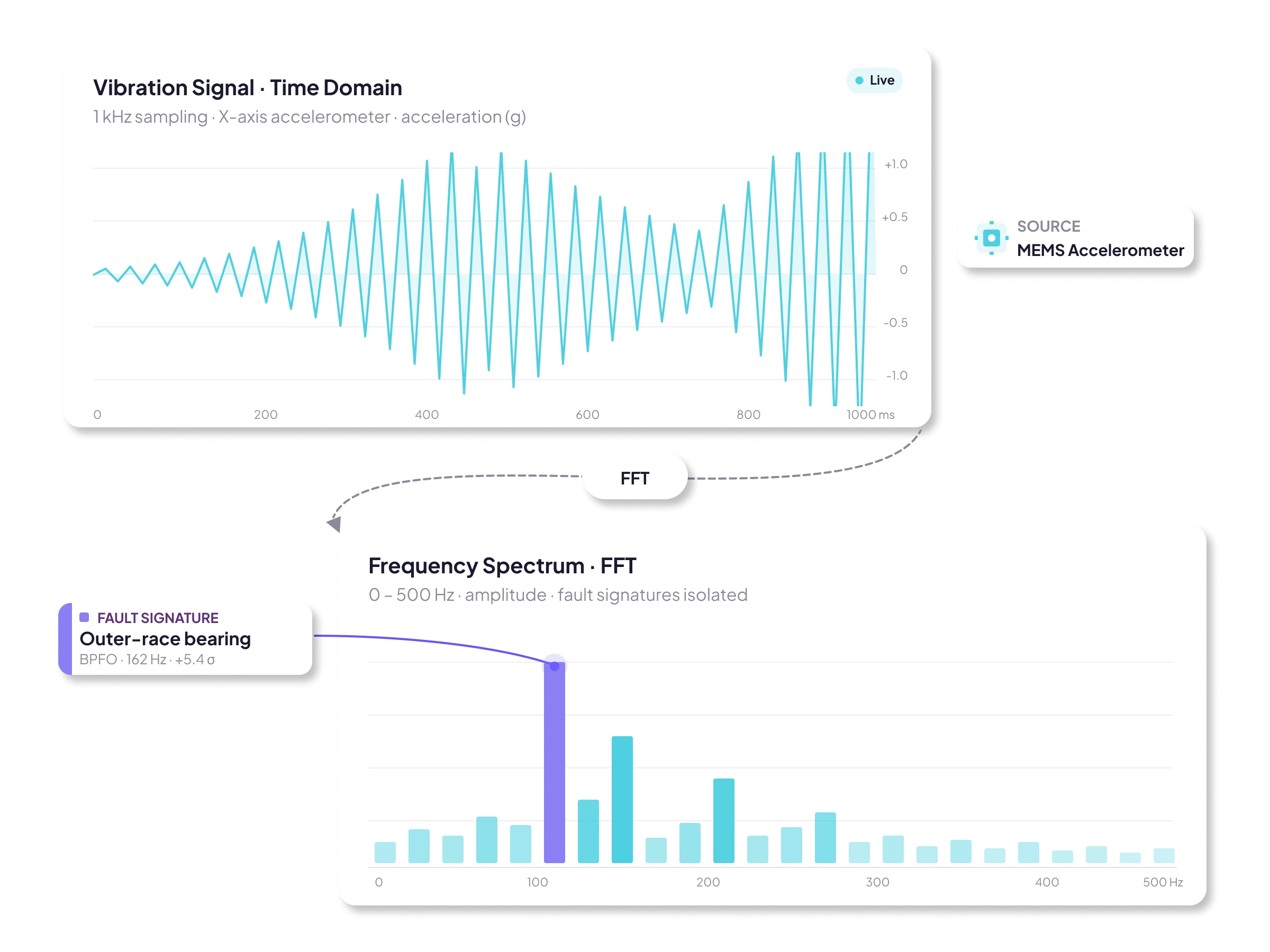
Analyze raw vibration waveforms in the time domain and transform them to the frequency domain to isolate specific fault frequencies, harmonics, and resonance signatures.

Move beyond fixed vibration thresholds with machine learning models that learn normal machine behavior and flag deviations long before they escalate into failure events.

IoT in Action


Product Overview
Turn raw accelerometer data from rotating machinery into the time-domain waveforms, frequency spectra, and ML-driven failure predictions that give reliability engineers the earliest possible warning of mechanical fault.
A developing bearing fault produces characteristic frequency signatures weeks before it causes a breakdown. Shaft imbalance creates specific harmonic patterns. Misalignment leaves its own fingerprint in the frequency spectrum. Ubidots ingests high-frequency vibration data from accelerometers and MEMS sensors, processes it in real time, and presents both time-domain waveforms and frequency-domain spectra through dashboards built for reliability engineers — giving your team the analytical tools to hear what your machines are saying.
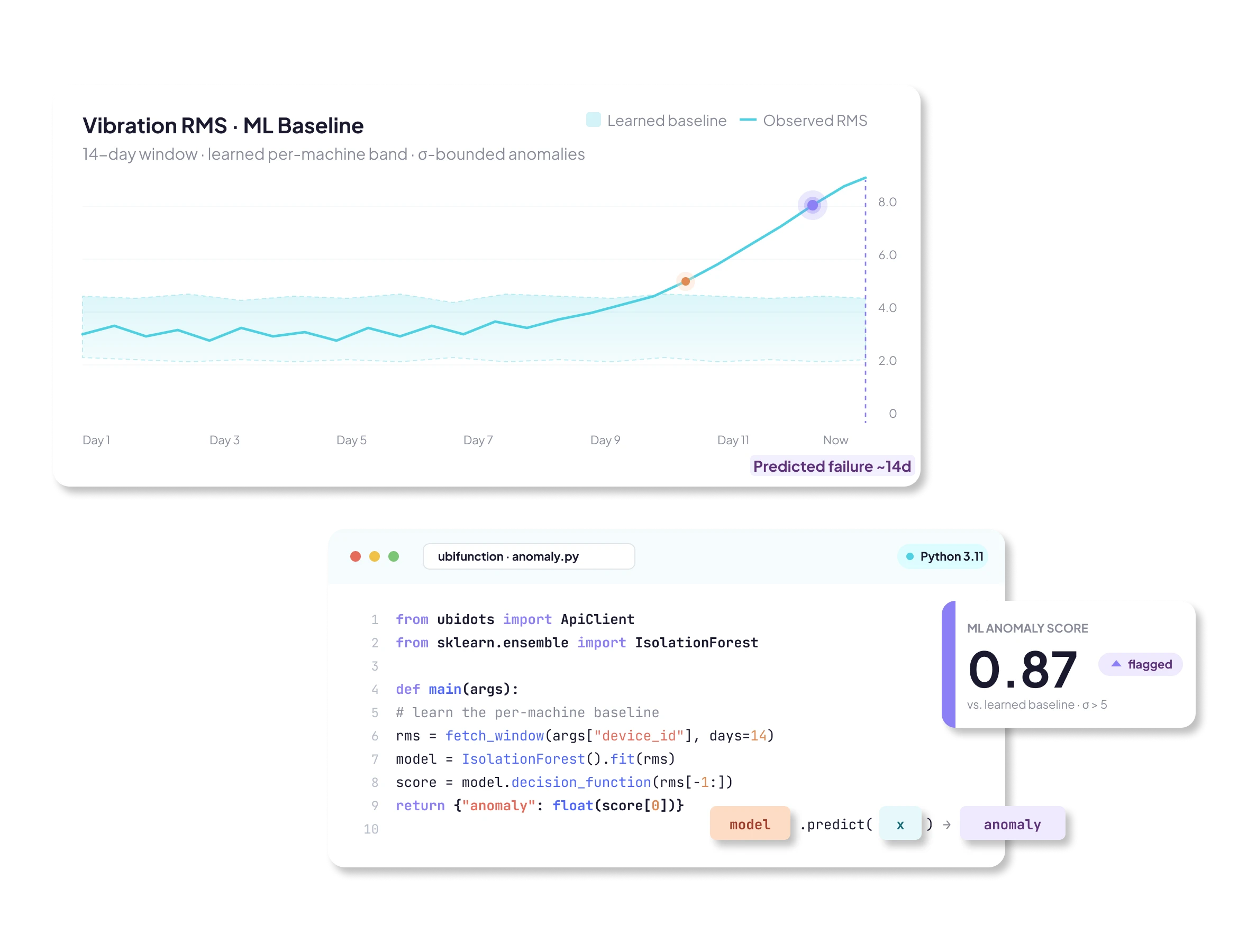
Fixed vibration thresholds catch obvious problems. Machine learning catches the subtle ones. With Ubidots, reliability teams can deploy Python-based ML models serverlessly via UbiFunctions to establish normal vibration baselines per machine, detect anomalous patterns as they develop, and generate failure predictions with enough lead time to plan maintenance without disrupting production.
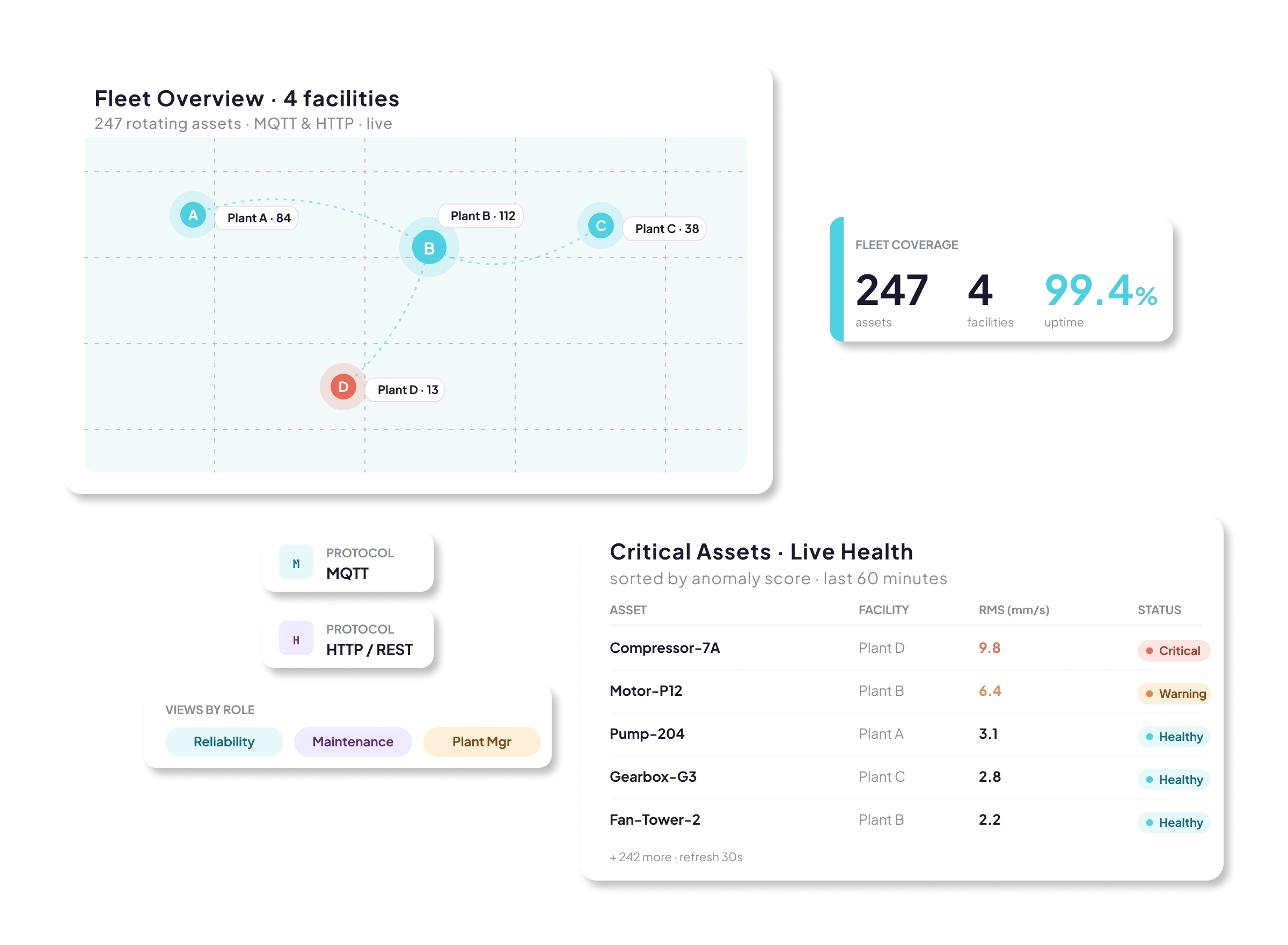
Whether you’re instrumenting a single critical compressor or deploying vibration monitoring across hundreds of motors, pumps, and gearboxes in multiple facilities, Ubidots scales with your program. Connect vibration sensors via MQTT or HTTP, organize assets by criticality or location, and give maintenance engineers, reliability specialists, and plant managers each the view they need to act.

Key Features
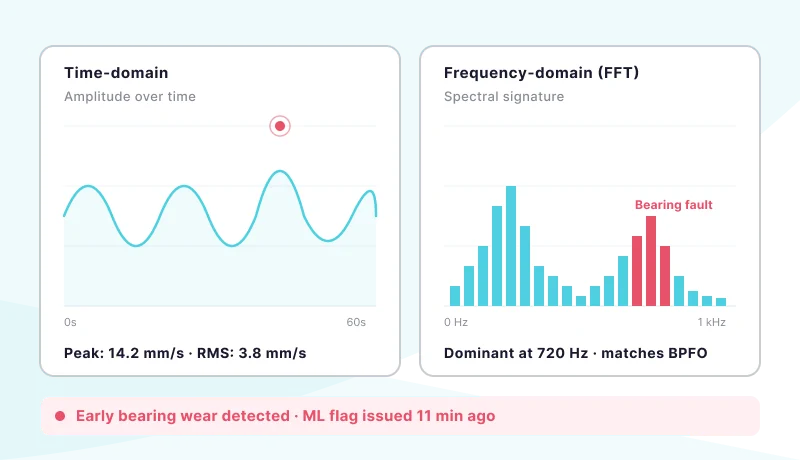
Analyze vibration data in time-domain and frequency-domain to detect early signs of mechanical failure.
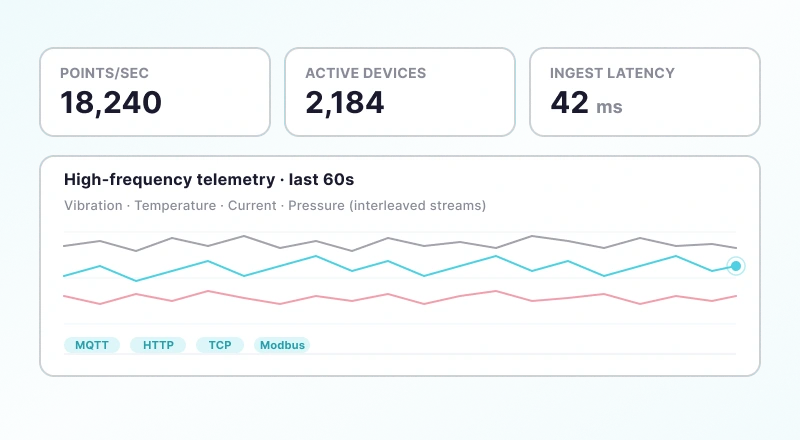
Ingest and process high-frequency sensor data from any IIoT device or protocol.
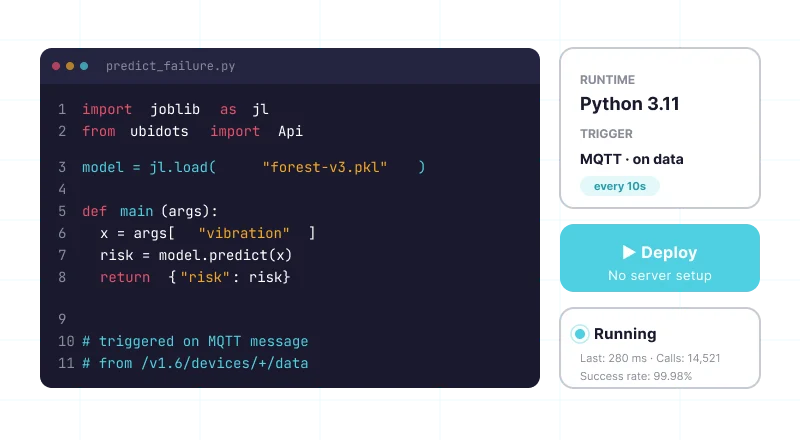
Run Python machine learning models serverlessly via UbiFunctions without managing infrastructure.
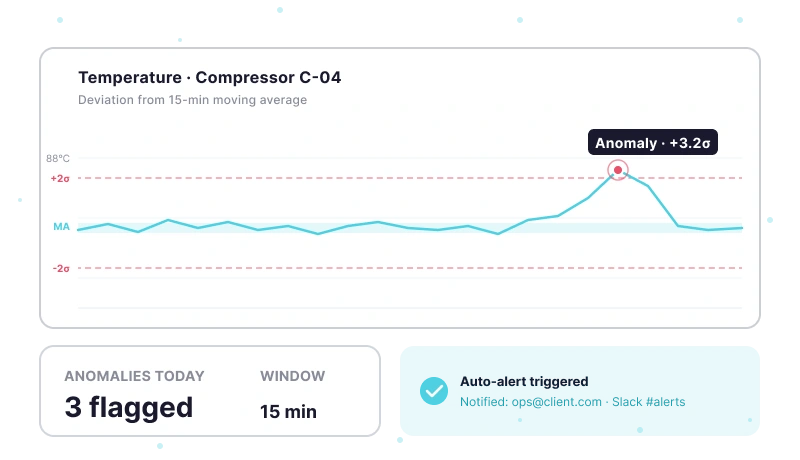
Flag unexpected equipment behavior automatically using configurable moving average algorithms.
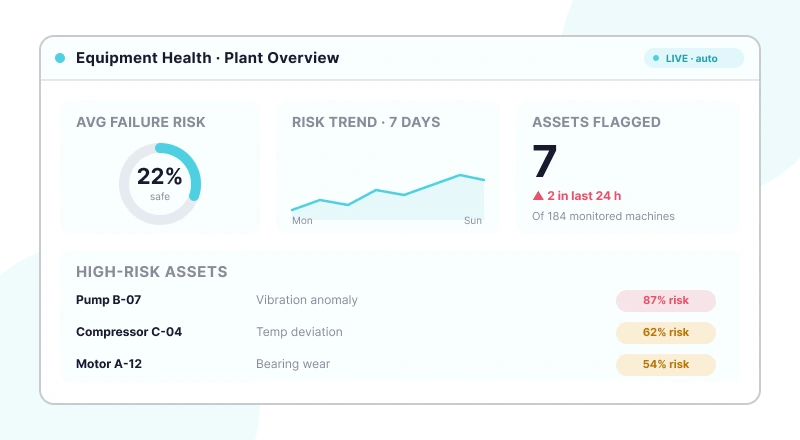
Visualize equipment health, predictions, and maintenance status in customizable live dashboards.
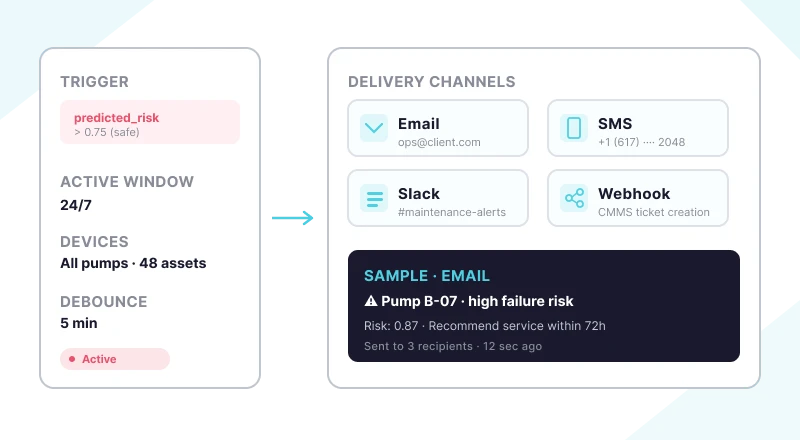
Receive instant notifications when sensor readings exceed predicted safe operating thresholds.
Quantify Environmental uses wireless IoT sensors and Ubidots dashboards to turn utility data into real-time insights, helping industrial clients monitor water, energy, and gas use, detect inefficiencies, and act before costs rise.

$250,000+ in annual client savings through optimized water, electricity, and gas consumption.
Millions of liters of fresh water conserved and tons of CO₂ emissions prevented driving measurable sustainability outcomes.
Improved operational oversight with real-time visibility into utility usage and equipment performance.
Success Story


Use Cases


Steve Barker
Founder & CEO
Prospect Control uses Ubidots to deliver remote tank level monitoring for industrial customers, replacing complex PLC/SCADA setups with a scalable, web-based IoT solution.
Results:


Darryl Schembri
General Manager
AIS Technology uses Ubidots to monitor electricity, water, and gas consumption across multi-tenant buildings, enabling real-time visibility, automated billing, and faster response to inefficiencies.
Results:


Onofre Tamargo
CEO & Cofounder
S4IoT uses Ubidots to remotely monitor irrigation systems in urban gardens, helping clients reduce maintenance costs, prevent plant loss, and shift from manual operations to a scalable subscription-based model.
Results:


Help & Support
Have questions about Ubidots? Here are some ofthe most common queries to help you get started.

Ubidots supports vibration-based condition monitoring for detecting bearing failures, shaft imbalance, misalignment, and mechanical looseness. Using time-domain analysis, you can apply moving average algorithms via Ubidots' Events engine or UbiFunctions to flag deviations from a machine's normal vibration baseline. For frequency-domain (FFT) analysis — useful for isolating specific fault frequencies — Ubidots offers a dedicated plugin for NCD predictive maintenance sensors that converts raw triaxial acceleration data into amplitude-frequency spectra, visualized through the Frequency Chart widget. This makes Ubidots a practical platform for condition-based monitoring of rotating machinery in manufacturing, oil & gas, and utilities.
Because high-frequency vibration sensors can generate far more data points per second than IoT platforms can ingest as individual readings, Ubidots uses a context-array approach: raw vibration samples are packed into an array at the edge (e.g., via a Node-RED function node) and sent as a single payload stored in a variable's context field. The Frequency Chart widget then reads that array to render the full spectrum — no data is lost, but the architecture requires edge pre-processing rather than point-by-point streaming. UbiFunctions, Ubidots' serverless Python environment, can then process these arrays to compute FFT outputs, RMS values, or run ML inference on demand or on a schedule. Note: the Frequency Chart widget requires an Industrial license or higher.
Yes. Ubidots' UbiFunctions lets you deploy Python-based ML models in a serverless cloud environment — no external servers required. You can schedule a function to run hourly, fetch recent vibration or sensor data via the Ubidots API, run inference, and write predictions back as synthetic variables on the platform. Those variables can then trigger automated alerts through the Events engine when a fault probability exceeds a threshold. This workflow works best when you have labeled historical data that includes failure events; the platform doesn't generate training data automatically, so data quality directly determines model accuracy.
Yes. Using Device Types and Templates, you define a standard vibration monitoring configuration once — variables, dashboard layout, alert rules — and replicate it across any number of assets. For deployments using NCD vibration sensors, Ubidots also supports over-the-air (OTA) remote configuration, letting you adjust sensor parameters like output data rate (50–25,600 Hz) or sampling duration from a central dashboard without local access. A "Global OTA" field enables batch reconfiguration across multiple sensor nodes simultaneously. Data is retained for 10+ years, and role-based access control lets you segment visibility by site or team, which is useful in multi-tenant industrial environments.