

Industries
Monitor customer equipment remotely, track usage for billing, and deliver the uptime SLAs that make service contracts viable.




Benefits

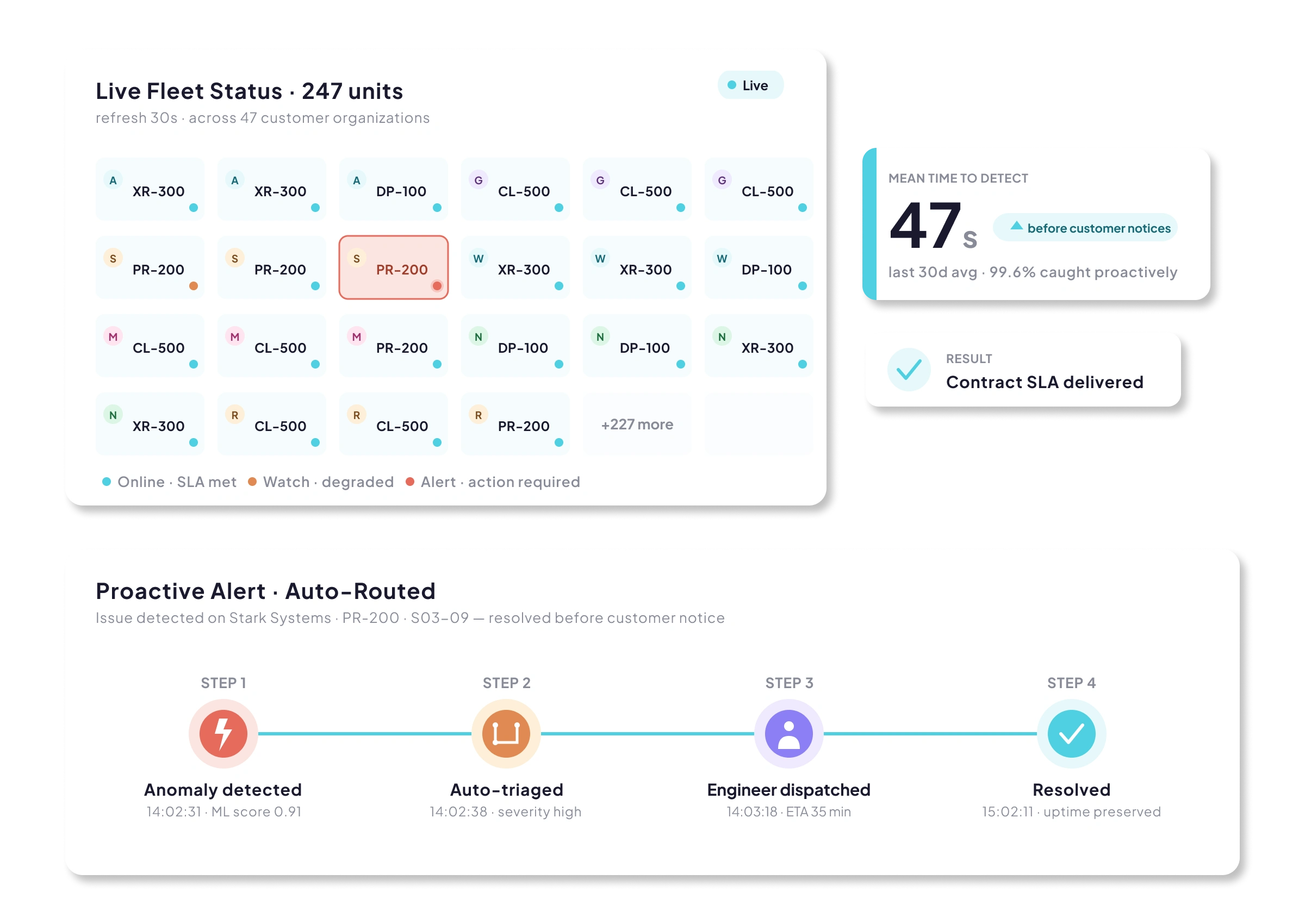
Monitor the real-time status, performance, and health of every unit deployed at customer sites — without rolling a truck or waiting for a service call.

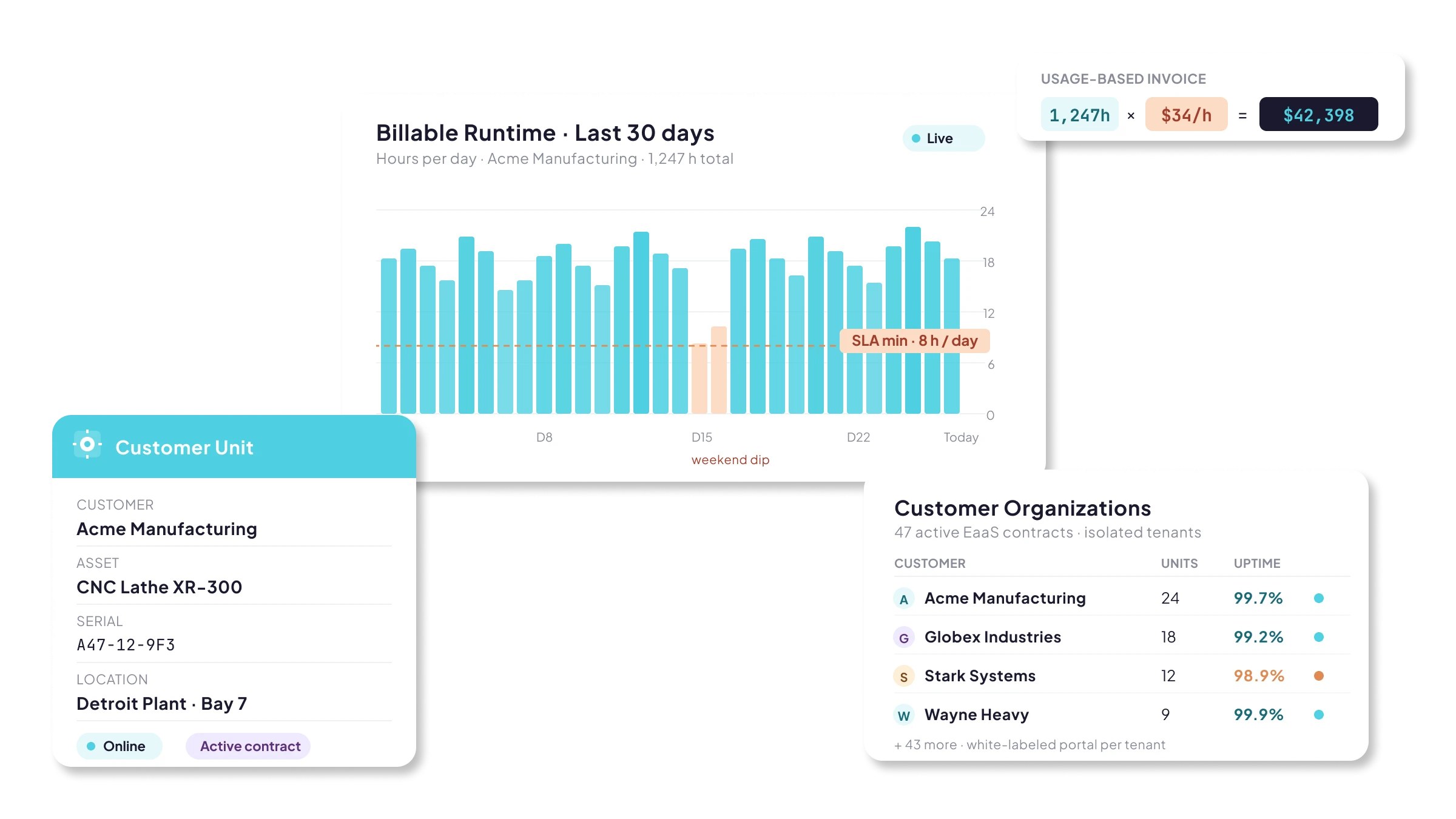
Automatically capture runtime hours, cycles, consumption, and operational data per unit — generating the accurate usage metrics that power subscription and pay-per-use billing models.

Detect equipment degradation signals before they cause failures — fulfilling uptime SLAs, reducing emergency callouts, and building the service reliability that retains customers.

IoT in Action


Product Overview
Power your EaaS business with the remote monitoring, usage tracking, and proactive maintenance capabilities that make service contracts deliverable — and scalable.
Every EaaS contract is a promise: the equipment will perform, and when it doesn’t, you’ll fix it fast. That promise is only keepable with continuous visibility into every deployed unit. Ubidots gives EaaS providers and OEM integrators a real-time view of every unit’s status, performance, and health — with automated alerts that trigger before a customer notices a problem, turning reactive service into proactive care.

Usage-based and outcome-based billing models live or die on data accuracy. Ubidots captures runtime hours, cycles, consumption, and operational events per unit — giving your billing, sales, and operations teams the reliable usage data they need to price contracts fairly, resolve billing disputes, and identify upsell opportunities based on real usage patterns.
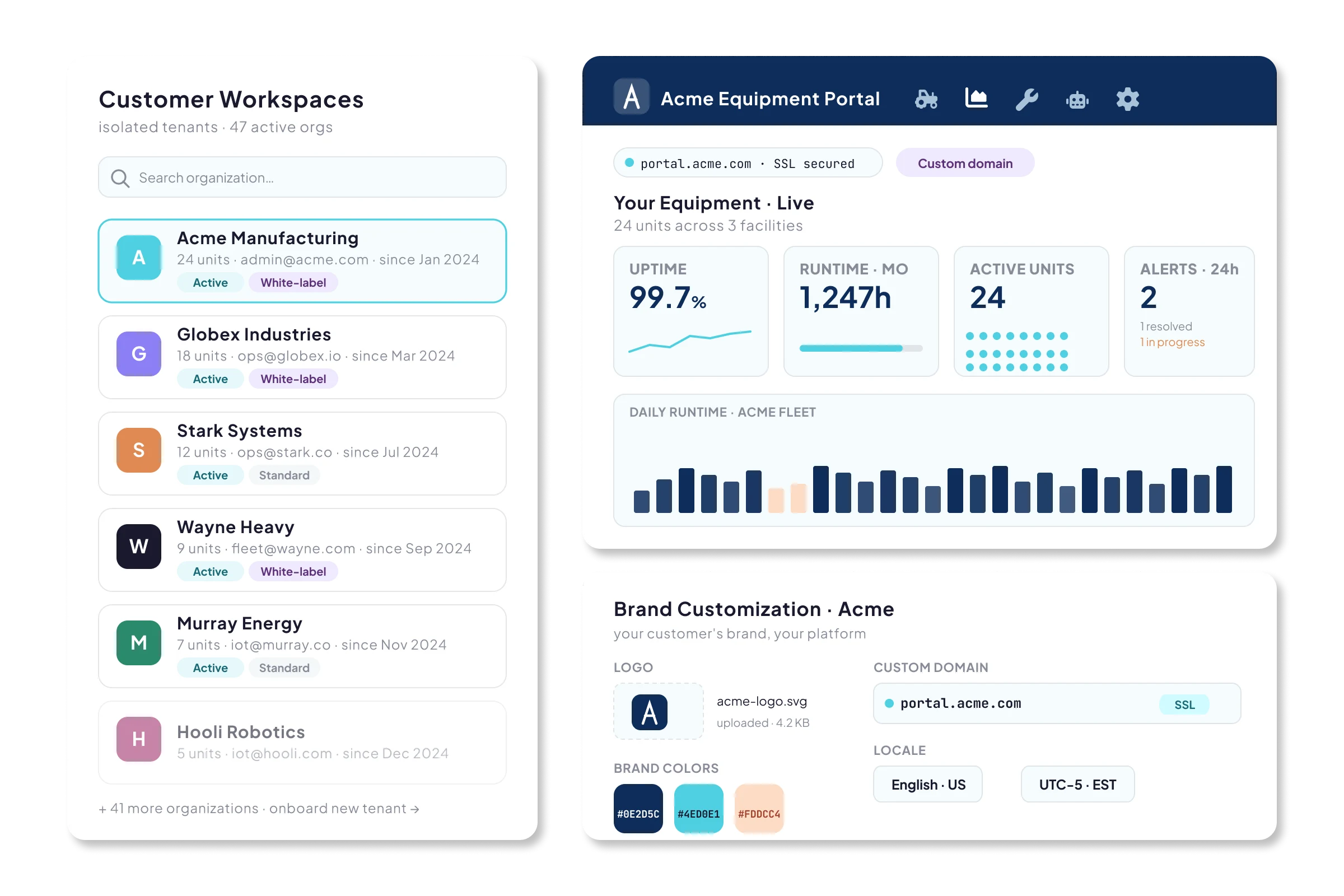
Ubidots’ multi-organization architecture lets you onboard each new EaaS customer as an isolated organization — their data, dashboards, and alerts completely separate from every other customer, while you retain full visibility across the entire deployed fleet. Deploy a white-labeled monitoring portal under your own brand, and give each customer exactly the view they need without exposing your entire platform.

Key Features
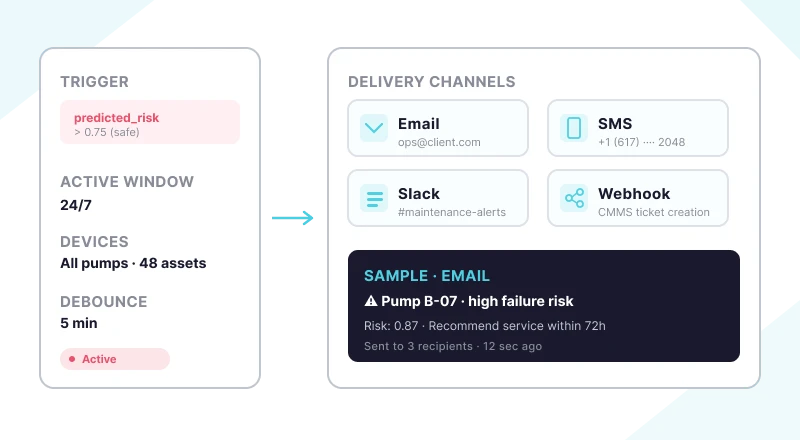
Receive instant notifications when sensor readings exceed predicted safe operating thresholds.
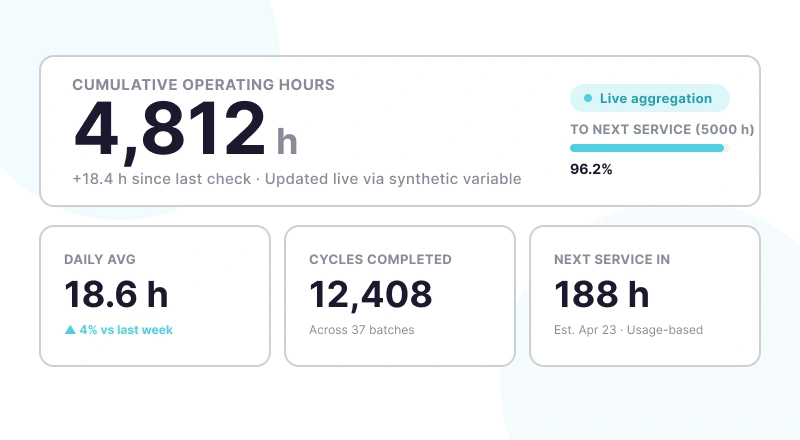
Monitor actual machine usage with synthetic variables to enable usage-based maintenance scheduling.
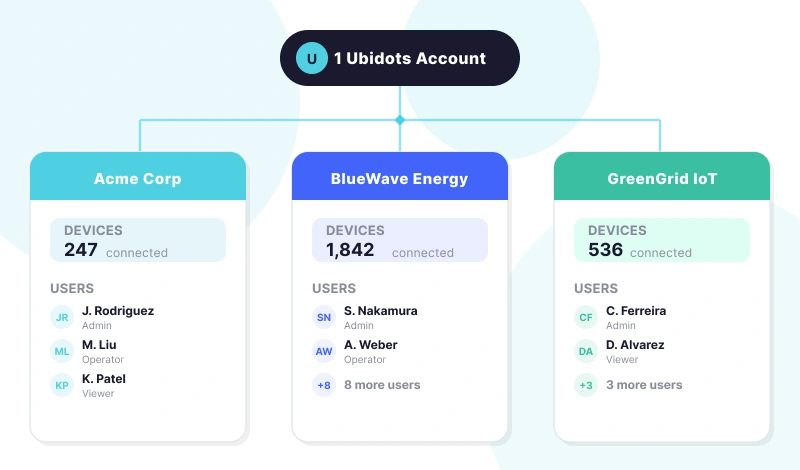
Serve multiple independent clients from a single Ubidots account using isolated organizations per customer.
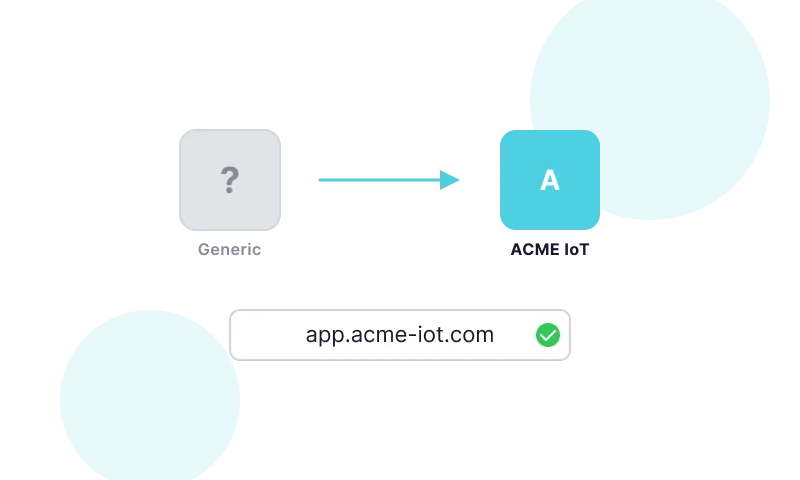
Replace Ubidots branding with your logo, custom domain, and email sender for a fully proprietary app.
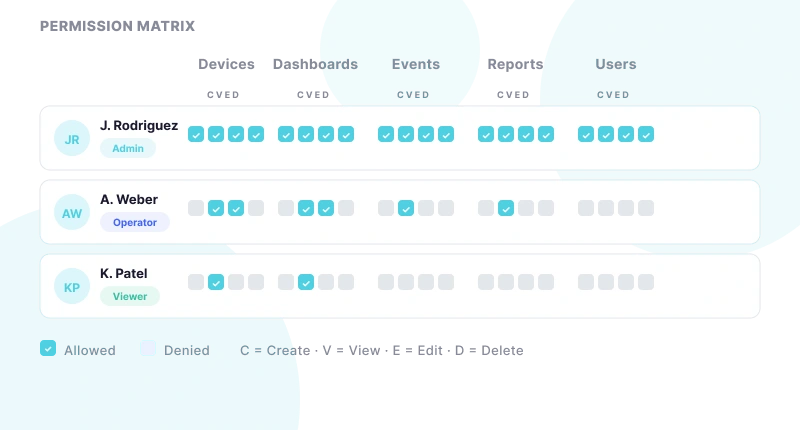
Assign create, view, edit, and delete permissions per user to control exactly what each person can do.
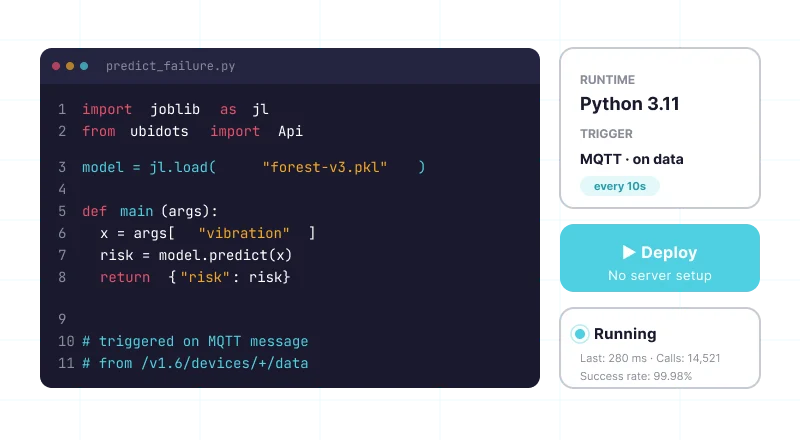
Run Python machine learning models serverlessly via UbiFunctions without managing infrastructure.
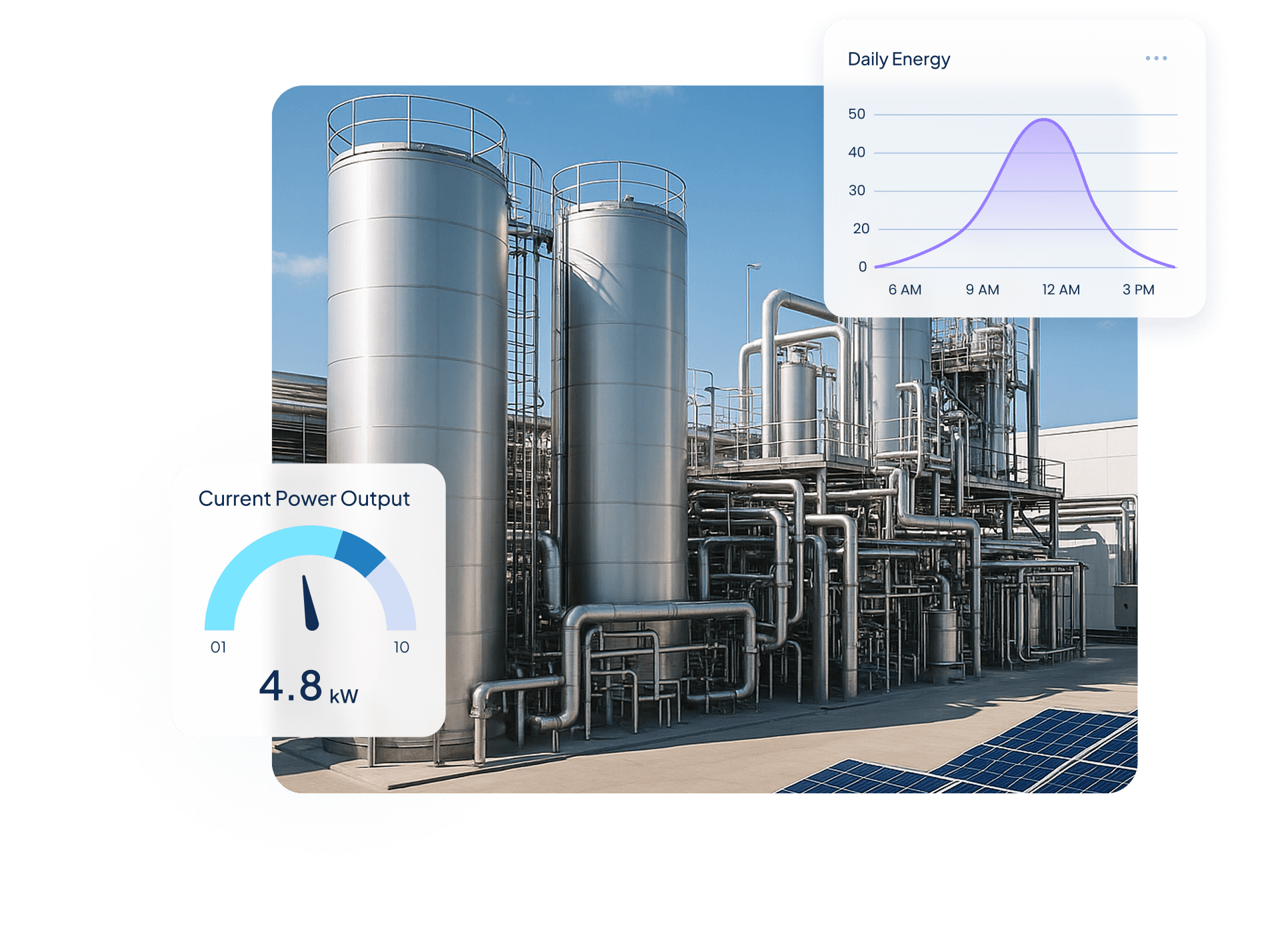
Quantify Environmental uses wireless IoT sensors and Ubidots dashboards to turn utility data into real-time insights, helping industrial clients monitor water, energy, and gas use, detect inefficiencies, and act before costs rise.

$250,000+ in annual client savings through optimized water, electricity, and gas consumption.
Millions of liters of fresh water conserved and tons of CO₂ emissions prevented driving measurable sustainability outcomes.
Improved operational oversight with real-time visibility into utility usage and equipment performance.
Success Story


Use Cases


Steve Barker
Founder & CEO
Prospect Control uses Ubidots to deliver remote tank level monitoring for industrial customers, replacing complex PLC/SCADA setups with a scalable, web-based IoT solution.
Results:


Darryl Schembri
General Manager
AIS Technology uses Ubidots to monitor electricity, water, and gas consumption across multi-tenant buildings, enabling real-time visibility, automated billing, and faster response to inefficiencies.
Results:


Onofre Tamargo
CEO & Cofounder
S4IoT uses Ubidots to remotely monitor irrigation systems in urban gardens, helping clients reduce maintenance costs, prevent plant loss, and shift from manual operations to a scalable subscription-based model.
Results:


Help & Support
Have questions about Ubidots? Here are some ofthe most common queries to help you get started.

Ubidots can track the metrics that power consumption-based and subscription revenue models — runtime hours, cycle counts, energy consumption, or any other operational variable your pricing formula depends on. Using synthetic variables, you can build cumulative counters that accumulate readings over time and reset on billing cycles, without writing backend code. These values are accessible via the Ubidots API, so they can feed directly into your billing system or be surfaced to end customers on a white-labeled dashboard. On Enterprise plans, the Extended Storage add-on keeps 10+ years of data, so historical usage records remain available for dispute resolution or audits.
Yes. Ubidots offers a white-label add-on that can be purchased separately, giving you a fully branded portal with a custom domain, logo, and color scheme, plus an app builder for layout and navigation. Each customer organization is isolated with its own access scope, so a customer only sees their own equipment. Role-based access control lets you define what each user role can view or configure within that organization. The result is a branded portal your customers log into directly, with no visible reference to Ubidots — which is particularly valuable when the monitoring experience is part of the service contract you're selling.
Ubidots' multi-organization architecture lets you create isolated environments for each customer, each with its own devices, dashboards, users, and alert rules — all managed from a single provider account. Device Types let you define a standard equipment configuration once and replicate it across the entire fleet, so onboarding a new customer account is a repeatable, low-effort process. Groups and tags let you filter and segment assets across customers for fleet-wide reporting, while role-based access control ensures customers never access each other's data.
Ubidots' Events engine lets you configure condition-based alerts on any variable — threshold crossings, moving average deviations, or inactivity detection — so your team is notified the moment equipment behavior signals a problem. For more advanced degradation detection, UbiFunctions lets you deploy scheduled Python functions that run inference on live sensor data and write a health score back to the platform, triggering an alert before the issue escalates. Combined with up to 10+ years of historical data on Enterprise plans with the Extended Storage add-on, you can also analyze failure patterns over time to identify which equipment types or operating conditions carry the highest risk, and adjust maintenance intervals accordingly.